If you are actively discerning a vocation to the Priesthood, Diaconate, Consecrated Life, or Marriage and you are looking for information to help in your discernment, BE SURE TO CHECK the section at the bottom of the right sidebar for the "labels" on all posts. By clicking on one of these labels it will take you to a page with all posts containing that subject. You will also find many links for suggested reading near the bottom of the right sidebar. Best wishes and be assured of my daily prayers for your discernment.

Sunday, January 6, 2008

Solemn High Mass at Sacred Heart Cathedral in Raleigh

What a glorious Mass! My first Solemn High Mass, and it was absolutely joyous.
As providence would have it I was able to assist (back row between Fr. Parkerson [celebrant] and Fr. Ferguson, FSSP [subdeacon]). Three of our seminarians became very sick last night, and two of them were unable to serve. Brendan Buckler toughed it out and served as the main MC for the Mass, with Adam Richard assisting. I received the call to serve this to afternoon as I was getting out of diaconate formation, and was very happy to be able to be a part of such a historic Mass - the first Mass in the Extraordinary form in the Cathedral in almost 40 years. I'm not sure how many prayers of thanksgiving I offered - I simply couldn't believe that we were there celebrating a Solemn High Mass. Of course prayers were also with the seminarians, Charles and Patrick, who I filled in for as one of the torch bearers.

More information about this Mass will be posted as soon as it becomes available.

Thank you Your Holiness for Summorum Pontificum!
Thank you Your Excellency for so faithfully implementing it!
Thank you Frs. Parkerson, Meares, and Ferguson for making tonight happen!

Deo Gratias!

Saturday, January 5, 2008

Married priests won't resolve vocations crisis: Ukrainian cardinal

From Catholic World News...

Rome, Jan. 4, 2008 (CWNews.com) - The Major Archbishop of the Ukrainian Catholic Church has authored an article for L'Osservatore Romano arguing that an end to clerical celibacy would not resolve the vocations crisis.

Cardinal Lubomyr Husar of Kiev noted that the Byzantine Church he leads-- the largest of the Eastern churches in communion with Rome-- allows for the ordination of married men. The marital status of priests does not determine the quality of their service to the Church, the Ukrainian cardinal argued. At the same time, he observed, the absence of the celibacy disciplinary practiced by the Roman rite has not eliminated the constant challenge of finding candidates for the priesthood.

Thursday, January 3, 2008

Right Here, Right Now

By Leon Suprenant January 3, 2008
Posted on CUF Blog

I spent a couple wonderful years with a religious community in the 1980s as I was discerning a possible vocation to the priesthood and religious life. One day, they brought in a well-known retreat master to give the two dozen or so seminarians a day of recollection.

The first words of the priest to begin the day of recollection really startled me. He bluntly said, “None of you are called to the priesthood.” I looked around the room at all the postulants and said to myself, “Boy, Father Tom (the community’s vocation director) sures knows how to pick ‘em!”

The priest then explained that our vocation is “now,” that we must respond wholeheartedly to the Lord right here, right now by being holy seminarians. In five or six years, God willing, the bishop will lay hands on some of us, and then–and only then–would we truly be called to the priesthood.

As it turned out, I wasn’t one of the men called to become a priest. Yet, this important lesson has always stayed with me as a lay Catholic.

A crucial part of the lesson is seek eternal life right now. This can be quite challenging given the pace of daily life in the world. Further, we already tend to think of eternity exclusively as the sequel to this life. In other words, we live our thirty or sixty or ninety years on this earth, and then when we die eternal life begins.

However, eternal life is a present reality. Sure, in this life “eternity” (literally a dimension outside of time) and temporality coexist, while only after we die will we experience eternal life in its fullness without the admixture of time. But make no mistake–there are seeds of eternity in us now. If there weren’t, we’d have no basis for believing that we will continue to experience life–the eternal, “abundant” life (Jn. 10:10)–after we die.

Scripture frequently presents eternal life as a present reality. For example, in John 17:3, Jesus says, This is eternal life, to know You, the one true God, and Jesus Christ, whom He has sent.” He doesn’t say, “This will be eternal life . . .”

The present moment is the junction between time and eternity. The past and the future are real, but they are exclusively temporal realities and thus lack the dynamism of “right here, right now.” God’s grace, which plants and nourishes in us the seeds of eternal life, is encountered in the present moment as we strive to live in God’s presence and accept His sovereignty in our lives.

Scripture does present us the case of St. Dismas, the good thief who converted at the very end of his life so that “this day” he was with the Lord in paradise. However, we can’t presume that when we come to the end of our lives that we’ll have the time and proper disposition to accept our Lord’s invitation. That’s a future thing. God speaks to us right here, right now.

We do well, then, to heed the Psalmist’s words, “If today you hear his voice, harden not your hearts” (Ps. 95:7). Or, as St. Paul puts it, “Now is the acceptable time! Now is the day of salvation! (2 Cor. 6:2).

Or, as a retreat master once told a bunch of fledgling seminarians, “Vocation is now.”

Wednesday, January 2, 2008

Houston Nun Marks 100th Birthday

A good article about Sr. Martha Sebesta who marked her 100th year on the Feast of Mary Mother of God. Sr. Martha is a member of the Congregation of the Incarnate Word and Blessed Sacrament in Houston, Texas. (Emphases mine)


Incarnate Word Convent marks a special day for a nun who has lived a life of humility, love and service

By RICHARD STEWART
Copyright 2008 Houston Chronicle

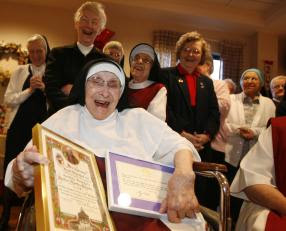
New Year's Day, a Catholic holy day honoring Mary, had an extra meaning for the sisters at Houston's Incarnate Word Convent — it was the 100th birthday of Sister Martha Sebesta — the oldest member ever to live in that convent.

The tiny woman wearing the traditional habit of her order was honored with a special blessing from Pope Benedict XVI, and a greeting from President George Bush, and mainly with the love and fond memories of her fellow sisters.


Frail now and confined to the wheelchair she refers to as her "Model T," she can no longer cook, clean or do the laundry with special care as she did for decades. But retirement is not in her plans. She can still pray and does that with fervor.

"The first thing she asks every morning is 'What time is Mass?' " said Sister Rosalia Purcell, the convent's superior general. "You'll find her in the chapel when nobody else is there. She has a lot of people she prays for."

The Sisters of the Incarnate Word and Blessed Sacrament were teachers when they came to Texas in 1852 and to Houston in 1873.

Since then, they have branched out into nursing, pastoral work and other duties.

Sister Martha has spent her life in more humble pursuits, keeping the convent going so her fellow sisters could work outside of it.

After being exposed to members of the order in her hometown of Shiner, she entered the convent in 1931 when it was downtown on Crawford. The convent moved to southwest Houston in 1983.

"This is all I ever wanted to do," she said. "I wanted to serve the Lord.

"I remember when I had the whole first floor," she said in a voice grown frail, but a smile that is still strong. "The kitchen, the laundry, I did it all."

The other sisters agree, "She could get out any kind of stain," Sister Teresita Partin said. "It didn't make any difference what it was, she could get it out."

Her special pride was making altar cloths and vestments look as perfect as they could in this world.

"If you didn't fold the laundry just right she'd make you do it over again," Sister Teresita said. "She was a perfectionist."

"She still is," said Sister Maria Eleanor Caisido, who is the youngest member of the convent. "If her place mat isn't just so she will straighten it," she said.

Other sisters remember the apple dumplings her Czech immigrant mother taught her to make. She still converses in Czech with Sister Dorothea Maroul, who also has a Czech background.

Her humility and love were an inspiration for the new members of the convent, said Sister Scholastica Schwarzbach.

For years she also served as the convent's receptionist.

"We feel like it was her prayers that have kept us all going," said niece Pauline Thompson, of Tehachapi, Calif.

Sisters of Life and Discernment


This is an old post from Adam's Ale by Bridget who is now with the Sisters of Life and was featured in the MTV Video about her...

Just a year ago, I was sitting in my spiritual director’s office. I was in the depths of discernment, and when I say depths I mean deep dark places of confusion, uncertainty and doubt. If you have ever discerned any vocation or even asked God what His will is for something, I’m sure you have been in a similar place. (Aside: God wants us to trust Him totally because that is from where our greatest joy will come as He allows us to be emptied of everything so that He is all we have to cling to, as we realize His steadfast love and mercy). I had already applied to the Sisters of Life, and was awaiting a response from the Sisters. This particular day I was pouring out all the reasons I couldn’t be a Sister…

Giving up my dream of being a doctor, missing my family, not playing volleyball, not being around to watch my brother and sister grow up, not being around as my nephew grows up, being afraid of a forever commitment, asking my family to sacrifice as I go, not being present to my friends etc…

After listening intently to the list, a list he had heard many times from me, my Spiritual director simply and matter of factly asked… “ Is He worth it?”

Is He worth it? Is Christ who was calling me to Himself worth it? Is He worth the sacrifice of family and friends? Is He who came to us in a stable worth my stepping out into the unknown and unheard of? Is He who was stripped of His clothes worth my putting on blue and white forever? Is He who cared so little about money that He gave the money bag to Judas worth me renouncing all personal ownership and making a vow of poverty? Is He who was nailed to the Cross for me worth my nailing my heart to the Cross with His? Is He who gave me life worth my giving my life back to Him? Is He who called the children to Himself worth giving up marriage and bearing my own children? Is He worth it? It is a simple question and requires a simple answer with astronomical implications.

The truth is, He IS worth it. He who is Love Himself came to us, to become one with us. He came to us so that our humanity might be lifted up into his divinity, both now here on earth and eternally. He who knew more deeply the pain the pain of separation from His heavenly Father and His dear Mother, He who knew He was calling His mother to a pierced heart, called Her anyway. And He exalted Her also. He who is love Himself, who pours Himself out to us continuously through the Eucharist. He who humbles Himself to come into our Hearts at every Mass, will bring us the greatest peace and joy when we surrender our hearts to His will and His Love. He will never be out done in generosity and so when we give our Hearts He will give us 100 fold in return. Mt 19:29

After being with the Sisters of Life for nine months and in preparing to enter the novitiate, I have come to know beyond the theoretical, through the intimate encounter with Christ who is my love and the source of all I am, that when I fall into His arms, despite the pain of sacrifice, He will guide me and lead me and take care of all my loved ones. He will shower His grace into my heart and bring me joy and peace than I could have never imagined. We were worth His dying, we were worth His thinking us into existence. He who is the omnipotent, ruler of the universe and intimately gentle lover of our souls is worth all we can give to Him.

BEAR WITNESS TO BEAUTY OF MARRIAGE AND THE FAMILY


VATICAN CITY, 30 DEC 2007 (VIS) - Today, Feast of the Holy Family, the Pope appeared at the window of his private study overlooking St. Peter's Square to pray the Angelus.

Addressing the thousands of faithful gathered below his window, the Holy Father explained how today "we celebrate the mystery of a God Who chose to be born of a woman, the Blessed Virgin, and to enter this world in the same way as all mankind. Thus He sanctified the family, filling it with divine grace and fully revealing its vocation and its mission".

Benedict XVI recalled a phrase much repeated by John Paul II - "the good of the individual and of society is closely connected to the 'good health' of the family" - indicating that "for this reason the Church is committed to defending and promoting the holiness and the natural dignity of the married state and its superlative value".

He then went on to address participants in a Meeting of Families being held today in Madrid, Spain, inviting Christian families "to experience the loving presence of the Lord in their lives" and encouraging them, "by drawing inspiration from Christ's love for mankind, to bear witness before the world of the beauty of human love, of marriage and of the family".

The family, "founded on the indissoluble union between a man and a woman, is the privileged place in which human life is welcomed and protected, from its beginning to its natural end. For this reason parents have the fundamental right and obligation to educate their children in faith and in the values that lend dignity to human existence.

"It is worth working for the family and for marriage", the Pope added, "because it is worth working for humankind, the most precious beings created by God". In this context, he called upon children "to love and pray for their fathers and siblings" and upon young people, "stimulated by their parents' love, generously to pursue their own matrimonial, priestly or religious vocation". To the elderly and the sick he expressed the hope "that they may find the assistance and understanding they need" and, finally, to married couples he said: "may you always rely on the grace of God, that your love may become ever more fruitful and faithful".

Tuesday, January 1, 2008

New and Improved Roman Catholic Vocations

Well it took a while, but I think I have made a helpful upgrade to this blog. At the very bottom of the sidebar on the right, I now have labels for all the posts on this blog. So for those of you who are discerning or doing research on certain topics, orders, etc., I pray this will be useful. I have tried my best to label accurately. Obviously there is a great deal of overlap on posts.

Five Men Seek a New Life at St. Benedict’s Abbey

Photo by Dan MaddenBrother Gregory Dulmes (left) and Brother Leven Harton have their arms outstretched during the singing of the “Suscipe” (offering of oneself), following their profession of vows.

By Dan Madden
Special to The Leaven

ATCHISON — Two monks made monastic vows and three men entered the novitiate at St. Benedict’s Abbey here on Dec. 8, the feast of the Immaculate Conception. Brother Gregory Dulmes professed his solemn vows, a lifetime commitment to the abbey. Brother Leven Harton professed simple vows, beginning a three-year period of formation before he may ask the community to accept him for final vows.

“There is a quiet side to being a Christian,” said Abbot Barnabas Senecal, OSB, in his instruction to the two men. “It is a pattern of life in which we learn acceptance, in which we learn to listen, in which we learn to be open and not closed.”

During the rite of profession, Brother Gregory lay prostrate and was covered by a funeral pall, while fellow monks sang the litany of saints.

“This was symbolic of dying to an old way of life and rising to a new one,” Brother Gregory said. “In a sense I had already been doing this by living as a monk, but this was making it permanent.”

Brother Leven agreed.
“This is three years of giving myself to God in a way I’ve never done before and constantly examining how to do it better,” he said. “But there is also a special grace that comes with it, a special union with God.”

Each professing monk was vested in a new garment. Brother Gregory received the cuculla, or cowl, to symbolize his acceptance as a solemnly professed member. Brother Leven received the traditional hood, to symbolize his new level of commitment.

Abbot Barnabas also received three young men into the abbey’s novitiate. Nicholas Padley, Adam Wilczak and Stephen Watson entered the one-year novitiate, receiving the monastic names Philip Neri, John Paul and Maurus, respectively.

Happy New Year!

Monday, December 31, 2007

Blood of Martyrs...Seeds of Faith


21 Church workers killed for faith in 2007

Rome, Dec. 31, 2007 (CWNews.com) - At least 21 Catholic priests, deacons, religious, and seminarians died for the faith in 2007, the Fides news service reports.

Each year Fides, an arm of the Congregation for Evangelization, compiles a full list of the Church workers who are killed while serving the Gospel, particularly in missionary territories. The preliminary list includes 21 names-- not accounting for lay workers.

The largest toll of clerics and religious who died for the faith came in Asia, where 4 priests, 3 deacons, and 1 seminarian were killed this year.
UPDATE: See the list of names and how these individuals were martyred at Independent Catholic News.

More on Msgr. Heliodore Mejak - Well Worth the Read

Special thanks to a reader who let me know about this article from 2003 in the Archdiocese of Kansas paper The Leaven


Faith of our Fathers: He's ancient of days. He can't see very well. And he has been known to be slow to change. But at age 93 Msgr. Heliodore Mejak has no intention of calling it quits.

By Bethanne Scholl
Special to the Leaven

The joke goes something like this: Old priests don't retire, they just . . .

Having trouble filling in the blank?

Maybe it's because there is no punch line.

Out of a lifelong love of their priestly vocation and a concern for their parishes, many old priests just don't want to retire.

It is probably safe to say that Msgr. Heliodore Mejak, who will turn 94 on St. Patrick's Day, is one of the oldest active priests in the country, perhaps even in the world.

He is by far the oldest active priest in the archdiocese, celebrating Masses seven days a week for the 200 or so families of his Kansas City, Kan., parish of Holy Family.

At 93 and counting, Msgr. Mejak could be said to be stubborn, firmly set in his ways. He is a little shy and has been described as "not exactly gruff."

He does not mince words, but speaks his mind - a sharp, intelligent and driven man. He shepherds his flock with the love of a strict parent.

Holy Family is one of the few remaining "national" parishes in the archdiocese - that is, a parish founded, usually in the early 20th century, to meet the spiritual needs of a particular immigrant group. Holy Family was founded in 1907 to serve the influx of Slovenian immigrants to the Strawberry Hill area.

"They wanted another Slovenian priest to take over," said Msgr. Mejak, of his assignment to the parish. "So the bishop sent me here 68 years ago."

"I can understand Slovenian, but I can't talk a word of it," he said. "My mother was Bohemian; my father, Slovenian. But the official language in Yugoslavia at the time was German, so we spoke German in the house."

"I still hear Slovenian and Croatian confessions," said Msgr. Mejak, "but no more German. They're all gone now."

Msgr. Mejak's father died when he was nine, leaving him as the head of the house. He took on his new role willingly, using his quick mind and capable hands to help his seamstress mother take care of his two younger sisters.

"I've always been very handy," said Msgr. Mejak. "I remember wiring our house when I was 16 years old. I could figure out everything. I was the first one to build my own radio when they came out. I had the best one in town."

Msgr. Mejak's pride and joy are the five brass model trains he has built over the past 40 years. Each part was painstakingly handcrafted with steady hands and a keen eye.

"I loved working with my hands," he said.

But about 10 years ago, Msgr. Mejak was diagnosed with a degenerative eye disease, leaving him legally blind. He no longer works with his hands or drives a car. And he has never been able to master the latest technological advances of a computer - he simply can't see the screen.

"Father has always been self-sufficient," said a parishioner. "He has never asked for help. I can't remember if he ever did. He never wanted a secretary or a live-in housekeeper.

"If he ever got a tear in his clothes, he'd just get out his Singer sewing machine and fix it," she said. "See, he learned that from his mother. When she was sewing and cooking, Father was right there, learning it too."

"Slovenians are a very determined people," she added simply.

That character trait served Msgr. Mejak well when the deterioration of his eyesight made it harder and harder for him to celebrate Mass.

"He enlarges the readings," said one parishioner, "by wearing large (magnifying) goggles over his glasses. He just has to read slowly [relying primarily on his peripheral vision].

"Sometimes he loses his place and he has to refocus. Then we go on. He is very dedicated and very determined and doesn't want to give up."

"We take it day by day together," she said.

"I memorize the prayer and the Gospel the day before," said Msgr. Mejak. "The Gospel is no problem after all these years, but sometimes the prayers are difficult."

"I can't see the headlines in the newspaper. They're too big, and I can only see a part of those letters," he said. "I magnify everything only about a quarter of an inch.

"I work that Xerox machine to death."

Msgr. Mejak still types the weekly bulletin, despite his failing sight.

"He has always been an excellent typist," said a parishioner. "He does make errors. He'll say, 'Was it very bad?' And we'll tell him, 'No, Father, it wasn't that bad.' He wants to do it."

While lay lectors have been a part of most parishes since the Second Vatican Council changes were implemented in the '70s, it has only been in the last four or five years that Holy Family has seen them.

"We don't have the sign of peace, no eucharistic ministers. I call it a 'chapel' type of service," said a parishioner. "Father started letting the children from the school read a few years ago, and after a while we were quite sure Father was OK about lectors. It was time for him to say 'yes.'

"When he absolutely cannot do it anymore, he'll say 'yes.'"

Holy Family still has a Communion rail that is used daily as well as tabernacle veils - vestiges of a church many Catholics today have never even seen.

"Father takes care of ordering the candles and the missalettes," said a parishioner. "He sets up the vestments and takes care of the tabernacle veils. We have things at Holy Family that you'll never see in any other church anymore. But we've never heard a complaint, ever."

Msgr. Mejak makes no apologies for the way his parish is run.

"I am old and traditional," he said. "I believe in old-fashioned things. I must do something that attracts people here. People come here from six other counties that don't really belong here. People go where they feel comfortable. A lot of people feel at home here. We're down to earth, not snooty."

When asked about retirement, Msgr. Mejak is matter of fact.

"If I got sick and I had to retire, I think I'd die in six months - out of boredom," he said. "At the end of seminary, I was told I'd never be a preacher. That's true. I'm a lousy preacher, but I'm a good lover, so to speak. I love the people here in the parish, and I think they love me. That makes up for a lot of it."

"Because of the shortage of priests, they're not going to send another priest here," said Msgr. Mejak. "Maybe they'd combine this parish with another or just close it down. I've baptized and married three generations here."

"We all talk about [his retirement] and think about it," said a parishioner. "But Father doesn't make any definite comments. He isn't interested in retiring. He wouldn't have anything to do."

"I don't know what I could do if I retired," said Msgr. Mejak. "I've never taken a vacation in 25 years. All my buddies died, you see.

"I still have friends. A group of us priests get together at Bishop Forst's and play cards and have dinner - talking the bull. They demand that I make chili for them."

"I still have friends," he added, "but not buddies."

"I was ordained to serve the people," said Msgr. Mejak, "and I can do it. That's a beautiful thing."

"I'm very happy here," he concluded. "We're out of debt. We have money in the bank. I love this parish."

God's "Housewife"

From an article in the Archdiocese of Miami's "Floriday Catholic":
God's "Housewife"
Colombian native becomes first Miamian to enter cloistered order of
Discalced Carmelites
By ANA RODRIGUEZ-SOTO - HIALEAH

ANA RODRIGUEZ-SOTO FC
Sister Anita enters the chapel where she will profess temporary vows to the Discalced Carmelite Sisters, a contemplative order.


At a time when vocations to the religious life are rare, Ana Carolina Bernal felt called to the rarest — to become a cloistered nun.

From now on, Bernal will be known as Sister Anita del Corazón Misericordioso (Sister Anita of the Merciful Heart).

She will live with 8 other Discalced Carmelite Sisters in the Monastery of the Most Holy Trinity on the grounds of Immaculate Conception Parish in Hialeah.

She will spend all of her days in prayer, leaving the convent only on rare occasions, and greeting visitors, including her family, through a grille.

“It is a life with God. It is a total surrender,” said the 28-year-old Colombia native, who is the first local vocation for the order.

If Bernal’s vocation is rare, it seems even more so considering her background. The youngest of three children, and the only girl, she came to the United States at age 9 and graduated from Coral Gables Senior High School before earning a psychology degree from Florida International University.

ANA RODRIGUEZ-SOTO FC
Behind the partition that separates the Discalced Carmelites from the world, Sister Anita professes temporal vows to her superior, Mother Alba Mery de Jesus.

While in college, she began attending prayer groups and taking courses with the Siervos de Cristo Vivo (Servants of the Living Christ), a lay association founded by the late Father Emiliano Tardif. Little by little, she became more and more involved in the life of the church.
“I was very attracted to the Blessed Sacrament, to the Eucharist,” Sister Anita said.

‘It is a life with God. It is a total surrender.’
Sister Anita del Corazón Misericordioso

Then she found out about the existence of the cloistered Carmelites and stopped by for a visit. She says she did not think much of them at first, but “a restlessness inside me urged me to return.”

ANA RODRIGUEZ-SOTO FC
Sister Anita reflects after receiving the symbols of her profession -- a crown of flowers symbolizing her espousal to Christ, a book containing the rules and constitution of the Discalced Carmelites, and a crucifix.

She started attending classes they offered every Saturday, and “felt God calling me more.”

In 2004, the Carmelites invited her to experience their lifestyle for three months.

“She stayed,” said her brother, Jose Bernal, a realtor in Raleigh, N.C., which is where their parents also live.

“I kind of suspected” she had a vocation, Bernal said, but like his parents, he was surprised his sister had been called to a life of prayer and contemplation.

“We were surprised because in this day and age it is so difficult for a young professional to enter a cloistered convent,” said Lucila Bernal, Sister Anita’s mom.

“She looks happy. No one has seen her bored yet,” said her aunt, Cecilia Aranzazu, who along with Sister Anita’s parents, brother and other relatives was present Dec. 12 for her profession of vows.

She already has spent one year as a postulant and two as a novice with the Discalced Carmelites. These first, or temporal, vows are for another three years, after which she can make her perpetual profession.

“I felt that I had to love God with all my heart. I had to be everything for him,” Sister Anita said of her vocation.

She compared the life of cloistered nuns to that of active religious by saying, “They dedicate themselves to the people. We dedicate ourselves exclusively to God. We’re like the housewives of God.”

ANA RODRIGUEZ-SOTO FC
Sister Anita stands behind the grille that now separates her from the world. She is committed to spending the rest of her life in constant prayer as a member of the contemplative order of Discalced Carmelites.


ANA RODRIGUEZ-SOTO FC
Separated by a grille, Sister Anita chats with relatives after her profession of vows.


FIND OUT MORE

The Discalced Carmelite Sisters arrived in Miami from their native Mexico in October 2001 at the invitation of Archbishop John C. Favalora.

He asked them to pray especially for the needs of the people of the archdiocese, for more vocations to the priesthood and religious life, and for the success of local pro-life efforts.

Currently housed at the former Mercy Convent on the grounds of Immaculate Conception Parish in Hialeah, the sisters are planning to move to a larger facility, the former Rader Memorial United Methodist Church in Miami Shores, as soon as it is refurbished to meet their needs — and as soon as they have raised the $2.5 million needed to pay for the refurbishing.

In addition to newly-professed Sister Anita del Corazón Misericordioso, the Discalced Carmelites have another young woman, a native of Nicaragua, entering as a postulant in January.

The group’s current superior, Mother Alba Mery de Jesús, attributes the vocations to “the mercy of the Lord. We do not promote ourselves, but somehow each one of us managed to get here.”

Sunday, December 30, 2007

The World's Longest-Serving Pastor of an Active Parish has Died--on Christmas day.


Active priest, 98, was devoted to parish
By KEVIN MURPHY and ALAN BAVLEY
The Kansas City Star

Mejak On Aug. 1, 1944, Heliodore Mejak said his first Mass at Holy Family Church in Kansas City, Kan. Sixty-three years later, the church is looking for a new priest.

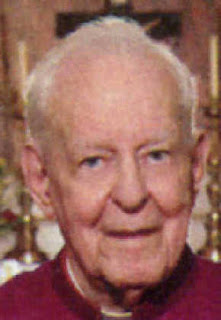
Mejak, 98, died Christmas Day, ending perhaps the longest tenure of a priest at a U.S. parish. Monsignor Mejak may also have been the country’s oldest active priest, according to the Archdiocese of Kansas City in Kansas.

“To be that old and to continue to function and to care for the community, that certainly shows his dedication and his love for his people,” said Thomas Tank, vicar general of the archdiocese. Mejak became a priest in 1935 and served under seven popes.

He will be remembered not only for his longevity but for his staunchly traditional Catholicism and his devotion to his parish, where he was also the church handyman, lawn cutter, financial manager and compiler of the weekly bulletin.

“He was a stellar priest,” said Mary Ann Grelinger, a former parishioner at Holy Family who wrote a 2006 biography on Mejak for a priests’ magazine called Homiletic & Pastoral Review. “He said Mass every day. He never took a day off or a vacation. Most priests do. He didn’t.”

Mejak celebrated Mass until about a week before he died, even though he had become progressively weaker, was losing his vision and used a walker.

“He couldn’t see,” said Kevin Fogarty, a Wyandotte County firefighter who has been attending Holy Family Church regularly for about 10 years. “He wore ‘welding goggles’ with huge magnifiers. When he said Mass, it was obvious he was reciting from memory. He couldn’t read it at all.”

Mejak may be best known for his resistance to changes in the church. Holy Family, a Slovenian parish, drew people who believed as he did. He was the last priest in the archdiocese to stop celebrating Mass in Latin in the wake of the Vatican II church reforms approved in the 1960s.

Mejak did not want laypeople to serve communion and said the host should only be served directly from a priest’s hand, rather than placing it in the hand of the recipient. He wanted people to kneel rather than stand for communion.

When Vatican II called on people to shake hands or hug as a sign of peace during Mass, Mejak ignored it.

“He said the presence of Jesus Christ on the alter should be the focus, not each other,” Grelinger said. “A sign of peace was something that distracted from the Eucharist.”

Kirk Kramer, an editor of the Digital Library of the Catholic Reformation in Virginia, attended Holy Family Church in the 1980s while a student at the University of Kansas. He recalled Mejak’s church as a refuge for Catholic traditionalists.

“His parish, his church was a haven of holiness,” Kramer said. “There was a sense of the sacred and the mysterious and the beautiful at a time when you had to look for that. When you went to Holy Family, you got the Mass of the church, authentic Catholic doctrine and not theological opinion.”

Charles Andalikiewicz, 77, had known Mejak since he was a boy growing up in the neighborhood of the church. Andalikiewicz is priest of Immaculate Conception Church in Louisburg, Kan.

“He was very humble, very loyal and a gentle man,” Andalikiewicz said. “He was also very scholarly.”

Mejak was a train buff who built electric trains in the church basement that he liked to show children, Grelinger recalled. He built the trains using old pictures and drawings as a guide.

Mejak graduated from what now is Bishop Ward High School in 1927. He went to St. Benedictine College in Atchison, Kan., and Catholic University in Washington and became a priest in 1935.

He served several churches in Kansas before being assigned to the Holy Family, where he had to learn the Slovenian language.
-

Saturday, December 29, 2007

Roman Catholic Diocese of Raleigh Men in Black Vocations Basketball Game II (2008)

The second annual Diocese of Raleigh Office of Vocations Men in Black basketball game (MIB2) will be this coming Saturday, January 5, 2008, at 11:00am. The "Duel in Durham" as it's being called will be held at the Emily K Center in Durham. The game will feature the MIB (Priests, Seminarians, and members of the Priesthood Discernment Group) playing against high students from Cardinal Gibbons and St. Thomas More Academy.

Last year's game was a great deal of fun, with a huge turn out of enthusiastic fans. It was certainly the largest vocations event in the Diocese last year, if not the last ten years. Unfortunately the MIB were unable to prevail in a game that, among other things, served as an exercise in humility. True to my competitive nature, I hope this years results will differ!

The gym will open at 10:30am, the game will start at 11:00am. Again this year we will introduce the seminarians at halftime, and His Excellency, the Most Reverend Michael F. Burbidge will help referee the game. Following the game the seminarians will lead everyone in praying the Rosary. There will be time after the game to speak with Bishop Burbidge, the Priests and Seminarians. Unfortunately, I will be unable to attend, as this is a Diaconate formation weekend for me and my brother candidates - unless my boss can get me out of it!

One other point of interest - John D'Amelio designed the MIB2 shirts and they look great. They will be available at the game, for a donation that will go to support the Office of Vocations. See the shirts below:


For those of you that missed last year's game, check out the video below from the Diocese of Raleigh which shows Bishop Burbidge, our Priests, and Seminarians in action:


Carmelite Sisters of the Most Sacred Heart of Los Angeles


Fr. Richsteig highlighted the Carmelite Sisters of the Most Sacred Heart of Los Angeles on a recent post and wrote that they were one of his favorite communities. I visited their websites and was certainly impressed! The community seems to be thriving, they are traditionally habited, and of course they look very joyful. If you get a chance take a look. I'll be adding their vocations link to my sidebar for women's religious.

Carmelite Sisters of the Most Sacred Heart of Los Angeles hompage.

Carmelite Sisters of the Most Sacred Heart of Los Angeles vocations homepage.

UPDATE: Someone posted a comment with a link to a slideshow of one of the sisters making final vows. Quite worth the time to watch. Check it out here.

Thursday, December 27, 2007

Beautiful Article in the Washington Post about Carmelite Nuns

Pictures are not from the article.


Walking With a Joyful Spirit

By Michael E. Ruane
Washington Post Staff Writer
Tuesday, December 25, 2007

In the dark of the early morning, a Roman Catholic nun in a brown tunic and black veil stepped from her cabin and walked to a nearby bell tower.

She rang two bells, calling her sisters to Christmas Eve prayer. Across the complex, other nuns emerged from their hermitages in the woods and gathered in a small chapel. From there, the 10 women embarked on a procession along pathways lit by the full moon, singing as they walked:

Sisters, Arise! Away with your sadness,

With love your hearts adorn;

All the Earth is full of gladness

Slumber not this happy morn.

The celebration of Christmas at Charles County's historic Carmelite monastery early yesterday began in cloistered quiet, behind a tall plank fence off a back road, two miles from Crain Highway and the glitz and malls and madness of the outside world.

It was marked with boughs of evergreen and holly cut from the woods, and arranged in the prayer corners of the sisters' wooden dwellings. It was celebrated with the song of women who have given their lives to prayer and seclusion. And it was observed with a reverence for the central theme of Christianity: that with the birth of Jesus, God became man.

It's "astonishing," one said. Why would God do that?

As the Washington region awoke yesterday to a final day of shopping, travel and preparation, the Carmelites rose before dawn to bring to a close the season of Advent, ending the period of joyful longing, as they put it.

Heaven's treasure let us crave, they sang as they walked through their 65-acre compound.

Him for whom our souls are yearning

Who comes all to bless and save.

The monastery, outside La Plata, traces its history to 1790. The sisters live in a fenced-in area within the complex. They often work alone in their small, one-story individual hermitages, which contain a bedroom, bathroom, workroom and back porch. They work as artists and seamstresses. One is a weaver. They make crafts for their gift shop, which has no clerk and runs on the honor system, and they also do clerical work to help support themselves.

The nuns gather as a group to eat and pray and rarely venture beyond the fence, let alone the compound. The goal is separation from the outside world.

The prioress, Mother Virginia Marie, 73, is the only one who regularly goes outside the enclosed area within the monastery. The grounds also have a public chapel and landscaped visitor area, just beyond the fence.

"It's wholly symbolic, our separation from the world," said Mother Virginia, who was Jane O'Connor of Tulsa before she joined the Carmelite order at age 17. "We've chosen this. We're not in prison."

The aim "is to do more intently what we have chosen to do," she said in an interview last week. "So that we don't have distractions. So we can pray better. So that we can concentrate on the Lord.


"It's a life totally dedicated to God," she said. "And we can do it best when we are free from many things. . . . Silence and solitude are very conducive to prayer, and prayer is what our life is all about."

The nuns come from many walks of life. One had been a Washington lawyer, Mother Virginia said. Another worked as a physical therapist, another a federal government employee.

"I had everything life could offer," said Sister Marie Bernardina, who grew up in Bowie and worked for the government before she came to the monastery 17 years ago. "I had money. I had friends. . . . I had a car. I had boyfriends. I just wasn't happy. I had a good job. I had no debts. I just was searching for more meaning in my life."

She is 42 now. Others in the monastery range in age from 27 to 80. There are 11 in all. They come from Japan, Puerto Rico, the Philippines and across the continental United States.

Their hands look slightly gnarled from work. And they are proud of their traditional clothing, or habits, which many nuns no longer wear.

They have a car, a TV -- which Mother Virginia said is seldom watched -- and a Web site.

And they celebrate a secluded and intense kind of Christmas.

"I don't think I could ever have Christmas out there again," said Sister Clare Joseph, 45, the former physical therapist from Missouri who came to the monastery eight years ago. "It's very solemn here. We kind of curtail our contact with people [prior to Christmas]. We don't write as much. We don't receive as much mail, phone calls.

"When we do have to go out, like for dentists or that sort of thing, I find it to be just a madhouse. And I can't wait to get back here," she said.

"I love Advent. It's a time to really deepen my relationship with God," she said last week as she sat behind the decorative metal bars in the monastery's reception room, clad in her habit and a gray cardigan.

Sister Marie Bernardina said: "Advent is really a time of longing. It's a longing for something more: What is our life all about? Where are we going as a human being when we die? What is the purpose of our life?

"All these things . . . float to the surface of our consciousness when we're preparing for Christmas," she said. "It awakens our longing for Christ. . . . It's a time of joyful waiting."

In the Christmas Eve procession, which Mother Virginia described yesterday, the group visited each nun's cabin. Each door was opened as a sign of welcome to Mary and Joseph, symbolized with small statues carried by the sisters. In the New Testament story, the traveling couple seek lodging in vain and Jesus is born in a stable.

"It might sound kind of goofy to people out there," said Sister Clare Joseph. "But it's symbolic of Christ coming to me. . . . It's a real beautiful thing."

The sisters visited other sites in the complex, singing as they went, then retuned to the chapel to pray. There would be more prayer and song as the day went on, and Mass scheduled for midnight.

Today, they said, they will gather for breakfast, exchange gifts and celebrate around their tree.

But all far removed from Christmas in the outside world.

"I feel we've gone way astray" on Christmas, Sister Clare Joseph said. "There's such consumerism in our society. Consumerism leads to . . . individualism, teaches our kids [to] demand and 'have to have this,' and 'I have to have this latest electronic,' and it's just a total rat race on where the thoughts are."

"I just want to tell people, 'Don't you realize God became a man? Do you realize how astonishing that is?' " she said. "I don't think people even think about that. . . . They're so intent on decorating their homes, and buying the latest, and giving more and better and prettier gifts, and then, on the flip side, wanting more and better and prettier gifts."

"And God became man!" she said. "Why? . . . Because He loves us so much. And I think that that is totally not in most people's purview at all . . . in our society."

Yesterday, as they ended their procession on the moonlit Christmas Eve morning, they sang:

Be with us in sleep and waking

Jesus, Mary, Joseph be

Ours in life and ours when dying

Ours for all eternity.

Tuesday, December 25, 2007

House Cassocks of the Seminaries in Rome


J.P. Sonnen posted this picture on his blog, Orbis Catholicvs, along with the information that these are seminarians from the Urban College in Rome. While many of the other seminaries in Rome have abandoned their unique house cassocks, the Urban College has not, and requires them to wear it until they are ordained a deacon.

Too bad the North American College has, from what I understand (could be wrong) almost entirely abandoned the house cassock. Although some time ago, I read that some seminarians were trying to bring it back. A little google search and low and behold I found this photo of a seminarian at the North American College in his house cassock:


And then I found the post below on The Commonplace Book of Zadok the Roman giving an explanation and description of the house cassocks of different seminaries in Rome:

Let me explain - currently in Rome the normal black priest's cassock (or soutane) is the seminarian's most formal outfit. Whilst it is everyday dress for some of the congretations, in general the diocesan seminaries in Rome reserve the cassock for altar service or attendance at certain lituriges and for formal occasions. Depending on the stage of formation and the custom of the particular seminary the every-day dress of the seminarian is either the Roman collar or lay-clothes. The Roman diocesan regulations specify that clerical dress is only required of seminarians after they have gone through the ceremony of 'Admisssion to Candidacy' which normally occurs a few months before dicaconate ordination. An exception to this is the practise of the North American College which insists that all its seminarians go through 'Admission to Candidacy' before they arrive in Rome to begin their theological studies. This, it seems, is a throwback to the now-defunct Italian practice of performing 'Admission to Candidacy' early in seminary formation becuase this exempted Italian seminarians from compulsory military service.
However, until the 1970s, the cassock was not the formal wear of the seminarian, but his everyday uniform and unlike today, most of the older Roman Colleges had their own distinctive style of cassock. Now, alas, it seems that only the Scottish, the students at Propaganda Fide and (on special ceremonial occasions) Americans retain the older dress. Consulting the 1900 Handbook to Christian and Ecclesiatical Rome by Tuker and Malleson and an old edition of Georgina Masson's classic Companion Guide to Rome we find the following descriptions of the seminarian dress of yore:
Seminary of the Diocese of Rome Purple Cassock and soprana with pendant strings and no sash.
Pontificio Provincale Pio Black cassock, violet sash, a full cloak
Vatican Seminary Dark purple cassock with cromson bindings and buttons, one crimson string decorated with the papal arms, buckle shoes
Capranica College Black cassock, black soprana of shiny cloth, stings, no sash, shoes with silver buckles
Propaganda Fide Black double breasted cassock, red pipings and buttons, scarlet sash and strings (photo at left)

Germanic College Scarlet Cassock, black sash, scarlet soprana with pendant strings (Masson notes that they had the nickname 'gamberi cotti' or 'boiled lobsters' and that their distinctive dress was imposed due to their reputation for uproarious behaviour)
Greek College Blue cassock, red sash and pipings, blue soprana with strings - out of doors: a black soprana with wide sleeves
English College Black cassock and soprana, black strings and no sash

Scots College Purple cassock with crimson sash, buttons and pipings. Black soprana with pendant strings (photo at left)

Irish College Black cassock with red piping, no sash, black soprana and strings
French College The first college to abandon collegiate dress for the priest's cassock, no sash
Lombard College Black cassock, violet sash, soprana and strings
Seminary of SS. Peter and Paul Priest's dress with a black sash
Belgian College Priest's dress with a black sash edged with red
North American College Double-breasted black cassock, blue pipings and buttons, crimson sash, pendant strings
South American College Black cassock with blue edgings, blue sash, black soprana and strings
Maronite College Black cassock, soprana and strings
Bohemian College Black cassock, maroon sash edged with yellow
Armenian College Black cassock with red pipings, out of doors: black coat with wide sleeves
College of St Boniface Black cassock with yellow pipings, black soprana with black pendant srings lined with red
Polish College Black cassock and soprana with green sash
Spanish College Black cassock with blue sash, round black cape with vertical blue pipings
Candadian College Priest's dress and no sash
Ruthenian College Blue cassock, soprana with strings, orange sash

Note - the Soprana was a long sleeveless coat, often with two long strings or streamers hanging from the armholes to signify the state of tuition. The 'sash' is also known as the fascia or more colloquially the 'belly band'.

Article on Fr. Groeschel, CFR, in the NY Times


From a New York Times article:

A Circle of Faith Grows in Unexpected Ways


Forty-five years ago, the Rev. Benedict J. Groeschel had a small idea.

Then the chaplain at the Children’s Village for troubled youths in Dobbs Ferry in Westchester County, he decided in December 1962 to take Christmas dinner, other food and a smattering of presents to the impoverished families of five children from the South Bronx and Harlem whom he worked with.

Those families mentioned others — nephews, cousins, friends who were also in need. He thought: Why not? So next year the circle widened a bit. Word spread in the neighborhood. A building superintendent or neighbor would mention other names. Each December the list continued to grow.

Before long, he realized he had begun something that couldn’t be stopped, a Christmas tradition with a regular cast of characters, a past as well as a present, one of those reminders that the more noble notions of Christmas can sometimes creep in amid the seasonal clutter of commerce, bustle and noise.

Pick your religion, the essence of the season is the enormous things that can flow from small ones — a birth among the poor in a humble stable, a day’s worth of oil that somehow burns for eight.

And so, when Father Groeschel and his crew of helpers went to the South Bronx for the 45th year on Saturday, this time with around 700 boxes of food and thousands of presents, the message was not just about the importance of service to the poor. It was also about the huge things that can come from tiny ones.

“As a psychologist, I have to say I have a Santa Claus complex,” Father Groeschel said on Friday, the calm day between the loading and delivering of the food and toys and their distribution. “But I never, ever anticipated that this would become anything like this.”

Actually, there’s a second reason why this Christmas is so special. It’s a miracle he has lived to see it. Father Groeschel, an author of religious books and a fixture on the Roman Catholic EWTN television network, was crossing a street in Orlando, Fla., on Jan. 11, 2004, when he was hit by a car. He was near death three times in the next month, particularly on the night of the accident when he had no blood pressure, heartbeat or pulse for about 20 minutes. A few days later, he almost died from toxins that were overloading his system, then later from heart failure while on a respirator.

The accident left him without much use of his right arm and trouble walking, but he recovered to a degree almost no one expected.

“They said I would never live. I lived,” he said. “They said I would never think. I think. They said I would never walk. I walked. They said I would never dance, but I never danced anyway.”

Father Groeschel, a Franciscan friar who is the director of the Roman Catholic Archdiocese of New York’s office of spiritual development, which assists priests, now presides over an ad-hoc partnership of the faithful for the Christmas operation.

In addition to hundreds of donors, it includes Teresa Catullo, a local woman who spends the entire year buying up hundreds of off-price toys and gifts, which clutter her house until packed and shipped off; Cathy Hickey, who has worked with him since 1986; Jim Hogg, who runs a homeless shelter in Bethlehem, Pa., but comes in every year to help load trucks and deliver the food and toys; and two women, Doris Reeves and Anne Duffy, who for the second year flew in from California to help out as needed.

“If we believe what we say we do, then we should put our words into action,” Mr. Hogg said. “The Bible says, ‘If you do this unto these, the least of my brethren, you have done it for me.’”

Father Groeschel, who is 74, with a long white beard that’s more Merlin than Santa, is considered liberal on social justice issues like poverty and immigration, and extremely orthodox on church issues like abortion and homosexuality.

He figures Christmas has long been in a struggle between the sacred and the temporal, between charity and marketing, tensions that are particularly out of whack now. But then that’s true in our society overall, where the notion of service to the poor that is the focus of the order he helped start seems as quaint as friars in cassocks.

“I’m the only person in Larchmont who wishes he lived in the South Bronx,” Father Groeschel said, in his home and office in what used to be a garage at the archdiocese’s Trinity Retreat House, overlooking a bay off Long Island Sound.

Still, there are consolations. On a frigid Friday, it feels astoundingly peaceful. There’s no television with the overheated cavalcade of daily astonishments in the news and the commercials for luxury cars with bows on top. Priests and fellows and helpers of various stripes pad quietly to and fro. For a moment, in this quiet corner of Westchester all is calm, all is bright.

Sunday, December 23, 2007

Interview with Msgr. Ganswein, Papal Secretary

Peter Seewald inteviewed Msgr. Ganswein for a paper in Munich. The interview is a rare glimpse into the Papacey via the Holy Father's personal secretary. The article was translated for Inside the Vatican magazine by Gerald Naus (Gerald Augustinus of The Cafeteria is Closed blog). I finally got around to reading it today and found it to be a fascinating read. I've posted the part of the interview which dealt with Msgr. Ganswein's vocation below:


PS: You wanted to become a stock broker.

MG: Inititally, I was, as the oldest, supposed to take over my father's agricultural appliances business but the happenings at the stock exchange interested me more. My idea was that there was a lot of money being made and that you had to be bright and fast. Later, a bit more mature, when I thought about it more intensively, I thought, ok if I can do all that and have money, what happens then ? Suddenly, existential questions took center stage. So I started to search and ended up, completely unplanned, coming across philosophy and theology.

PS: A long process.

MG: And a difficult one. At first, the world of theology drew me close very strongly, the priesthood was added as a second step. Of course celibacy was also a question. At some point I felt that I couldn't drive at half speed, either I'd do it completely or I'd quit. A little theology, that's not possible. So, step by step, I approached the priesthood.

PS: A quote from one of your homilies, on the occasion of some ordinations: "You are granted to know that you have a dignity that distinguishes you from all who aren't priests. You are allowed to have the consciousness that you are doing something great, that you are allowed to do something great." Pretty aloof.

MG: I'd say that again without ifs ands or buts.

PS: You take it seriously.

MG: Yes, I do.

PS: It also sounds a bit romantic.

MG: I don't think so. They are words that were made true by life, and life wasn't romantic. The sentences quoted by you may sound a bit ceremonious on paper but behind them there is a lot of personal experience and I did not want to keep it from the new priests that there is something grand ahead of him, that it costs something and that he has to be willing to pay that price.


The Rumors Were True - the Archdiocese of St. Louis to Expand Seminary

More evidence that the "vocations crisis" may have more to do with an "orthodoxy crisis" than an actual shortage of vocations. The article below is from the St. Louis Review Online:


Archbishop Announces Seminary Expansion

by Barbara Watkins, Review Staff Writer
--------------------------------------------------------------------------------

Mark Kempf
KENRICK-GLENNON SEMINARY
Archbishop Raymond L. Burke has announced the start of a major renovation and expansion of Kenrick-Glennon Seminary in Shrewsbury.

The seminary has 111 seminarians, an almost 50 percent increase in enrollment over last year. While the growth is welcomed by the archbishop and Msgr. Ted Wojcicki, president-rector of the seminary, it also prompted the need for maintenance work, renovation and expansion of the physical plant.

Msgr. Wojcicki explained, "As a 78-year-old body has more aches and pains, so our 78-year-old building needs some significant infrastructure attention. Many priests ordained from our seminary will remember the loud clanging of the heating pipes; they are still clanging._Also the requirements of modern technology make much greater demands on our electrical system._It will be safer and helpful to our mission to be able to address these needs."

He continued, "Because we are blessed with more seminarians recently, we have need for more student rooms. Temporarily we have even placed rows of beds, barracks style, in the West Dorm; this approach assists with some of our vocations promotions activities but is not a long-term solution."

Msgr. Wojcicki, at the request of the archbishop, initiated a study of seminary facility needs by Mackey Mitchell Architects.

That results of that study include the following work planned for Kenrick-Glennon Seminary:

The building’s electrical system, heating and ventilation system and the plumbing system will be renovated, in that order. Archbishop Burke called these renovations "essential to the safety and health of the residents of and visitors to Kenrick-Glennon Seminary."

The West Dorm (currently a multi-purpose space) will be renovated, creating approximately 17 individual rooms for seminarians.

The former student rooms on Third Floor West, currently faculty offices, will be returned to residential use, providing 15 individual rooms for seminarians.

Plans will be finalized for a new addition to provide a library and faculty offices (with the present library converted into classrooms and faculty offices) and expansion of the dining room to accommodate the increase in residents and provide a public area for guests.

Once the library and faculty office addition is complete, the faculty offices on the Third Floor on the north side of the building will be relocated, thus regaining three priest residences, two visitors bedrooms/ studies and a small chapel.

St Joseph Chapel will be renovated. In a Dec. 15 letter to priests, Archbishop Burke said plans for the chapel renovation have been in development for some time. "The renovation aims at increasing the beauty of the chapel, in particular, the sanctuary, as the heart of the seminary, and attaining its capacity," the archbishop wrote.

The archbishop made the announcement detailing the study results and immediate plans to the seminary community Dec. 14. He then wrote to the priests in the archdiocese, notifying them of the information.

The study was undertaken to address what Archbishop Burke called "three essential and urgent needs" — the safety and health of seminary residents and visitors; appropriate accommodations for the growing number of seminarians; and hospitality to guests, who include "prospective seminarians, directors of offices of vocations, sponsoring bishops, and the priests and other faithful of the archdiocese."

Msgr. Wojcicki said, "These are changing times. When the seminary was built, it was more like a monastery, with few visitors; most staff was priests and religious. Now there are many visitors important to the mission of the seminary, including sponsoring bishops, vocations directors, parents, benefactors and alumni. Now with many lay staff and these welcome outside visitors who are essential to the mission of the seminary, there are many additional demands on the facilities, particularly office and meeting space."

Archbishop Burke said the study been carried out with attention to the archdiocese’s long tradition of seminary education and to the priestly formation requirements of the U.S. Conference of Catholic Bishops. It was also done with respect for the architecture of Kenrick-Glennon Seminary and for the appropriate boundaries between public areas, offices and residential spaces.

Msgr. Wojcicki explained, "In addressing our facilities needs to fulfill our mission, it is important that we make the best use of the existing space by renovating wherever possible, returning spaces to their originally intended use, and keeping separated office, residential, and public spaces." Msgr. Wojcicki praised the archbishop for his leadership in providing for the needs of the seminary.

In his letter to priests, Archbishop Burke wrote, "In addition to the finalization of the plans of the renovation of the seminary and new addition to it, planning of the funding of the needed maintenance and improvements is in process."

The archbishop thanked Msgr. Wojcicki for his efforts and thanked the faculty and seminarians for the sacrifices that would be necessary to carry out the work on the seminary. He said that these planned changes are part of a long-range study for the seminary developed by Mackey Mitchell Architects as a result of the study.

"These steps address only the essential and most critical needs. It is hoped that, over time, the total plan may be realized," the archbishop wrote in his letter to priests.

Friday, December 21, 2007

Bishop to Ordain 35 Permanent Deacons


From the "Catholic East Texas" Newspaper
By SUSAN DE MATTEO

(comments mine)

TYLER – Bishop Álvaro Corrada, SJ, will ordain 35 men to the permanent diaconate at four Masses this month.

The group ordinations will be celebrated at 10 a.m. Dec. 8 at the Cathedral of the Immaculate Conception in Tyler, Dec. 15 at St. Mary Church in Longview, Dec. 22 at Sacred Heart Church in Nacogdoches and Dec. 29 at Sacred Heart Church in Texarkana.

The men to be ordained represent 23 churches in the Diocese of Tyler and, after ordination, will bring the number of permanent deacons working in the diocese to 88.

Felix Ramos, slated for ordination Dec. 22, will be ordained for the Archdiocese of Galveston-Houston. His archdiocese did not have a deacon formation program active at the time he wished to begin formation, so he was given permission to join the Diocese of Tyler’s program, according to Deacon Rubén Natera, vice chancellor for the Tyler Diocese.

Scheduled to be ordained Dec. 8 in the Cathedral of the Immaculate Conception are:

Tyler – Shaun Black, Rufino Cortes, Steve Curry and Jack Rounds, cathedral; Remigio Alfaro and José Angel Tiscareno, Our Lady of Guadalupe Church;

Canton – Jonathan Ben Fadely and Alan Stehsel, St. Therese Church;

Crockett – Ramiro Romo, St. Francis of the Tejas Church.

Flint – Clarence Black, St. Mary Magdalene Church;

Gun Barrel City – Juan A. Cázares, St. Jude Church;

Lindale – Dennis King, Holy Family Church;

Mineola – Fidencio Ramos, St. Peter the Apostle Church;

Scheduled for ordination Dec. 15 in Longview are:

Gilmer – Ricky Yelverton, St. Francis of Assisi Church;

Hallsville – Robert William Rhodes and Gregorio Sanchez, Our Lady of Grace Church;

Kilgore – Lino Huerta and Isidro Sanchez, Christ the King Church;

Longview – Scott Daniel, Joel Gonzalez, Francisco Lopez and Nelson Petzold, St. Matthew Church; Vincent James Wilson, St. Mary Church;

Marshall – Magdaleno Aguirre and John Sargent, St. Joseph Church.

Through their ordination, deacons are configured expressly to Christ the servant and are called to be ministers of service and charity.

“The diaconal ministry is rooted in the Bible,” said Father Eduardo Nevares, assistant director of the vocations office. “In the Acts of the Apostles, because the apostles, the first bishops, were so overwhelmed with trying to administer their growing churches, they chose seven men from the community to care for the widows who were being neglected (Acts 6:1-7). So from the very beginning, the deacons were ordained to serve those in need in their communities.” (or actually assisting with the administration in general, allowing the Bishops to "minister to the Word")

Father Nevares said that particular charism manifests itself in the role and life of the deacon.

“Deacons are ordained clergy,” he said, “and, together with priests and bishops, they complete what the Patristic Fathers refer to as the ‘fullness of the church hierarchy,’ or the fullness of holy orders. They are not ‘substitute priests,’ but neither are they ‘glorified altar boys.’ They are ordained ministers, sharing in the Sacrament of Holy Orders with bishops and priests, but they have their own unique vocation, which neither priest nor bishop can or should fulfill.” (keep in mind that every Priest and every Bishop are ordained Deacons, so this statement, while well intended, is a bit erroneous. Every Priest and Bishop CAN and DOES fulfill the role of Christ the Servant. However, I believe I understand what Father Nevares is saying - the Diaconate is a vocation in and of itself, unique ministerially, and distinct as it relates to the presbyterate and the episcopate.)

Liturgically, deacons can perform weddings and baptisms and preside at funeral services outside of Mass. They can preach and teach and lead prayer services. They are, however, restricted from consecrating the Eucharist, anointing the sick or hearing confessions.

At Mass, deacons are ministers of the cup and of the word, proclaiming the Gospel and distributing the Blood of Christ (Deacons are Ordinary Ministers of Holy Communion, so they can also distribute the Body of Christ). Beyond the church, out in the world, deacons also are called to be ministers of the word, Father Nevares said, proclaiming the Gospel not in reading it, but in living it.

“The deacon is a witness,” Father Nevares said. “Through his marriage, through his family life, through his job, through his care and concern for the people around him, through what he does much more than what he says, the deacon is a witness to Christ the servant, Christ who brings comfort and compassion, Christ who cares for the poor and the suffering.

“Therefore,” Father Nevares said, “the deacon has the responsibility and the obligation to know his community, to know what problems and needs beset that community, and to know what resources are available in the community for people in need. Because the deacon comes out of a particular community, he knows that community with all its history, all its good and bad, as a priest probably never will ("As a Priest probably never will" - say what? I really must protest this idea that Priests live in an ivory tower and have no idea what is going on in the community, in the lives of the common folk. Priests today are very aware of what is going on in their communities, perhaps moreso than most Deacons). And he naturally(?) knows who in his community is most in need of the service of charity. The deacon must be the face of the church’s charity, which is Christ’s charity. It is the deacon who takes Christ’s charity into the world.”

Deacons serve many roles. In the Diocese of Tyler, deacons have long been active in prison and hospital ministry, and in such ministries as St. Vincent de Paul. At the chancery, Deacon Rubén Natera is vice chancellor, Deacon Rick Lawrence is director of discipleship, and Deacon Jerry Besze is co-director of family life with his wife Mary.

In the end, though, job titles and descriptions have nothing to do with the diaconate.

“The only real job description the deacon has is in the Bible,” Father Nevares said, “in Matthew’s Gospel: ‘Whatever you did for the least among you, you have done for me.’ Take care of and love the people of God; that’s what a deacon does.”

Thursday, December 20, 2007

“O Priest, who are you? You are not yourself..."

Hat tip to Crescat who gives a tip to Ecce Agnus Dei for this post:


“O Priest, who are you?
You are not yourself because you are God.
You are not of yourself because you are the servant and minister of Christ.
You are not your own because you are the spouse of the Church.
You are not yourself because you are the mediator between God and man.
You are not from yourself because you are nothing.
What then are you?
Nothing and everything.
O Priest! Take care lest what was said to Christ on the cross be said to you:
‘He saved others, himself he cannot save!’”

-St. Norbert, Founder of the Canons Regular of Premontre


Bishop to Ordain 35 Permanent Deacons

By SUSAN DE MATTEO

TYLER – Bishop Álvaro Corrada, SJ, will ordain 35 men to the permanent diaconate at four Masses this month.

The group ordinations will be celebrated at 10 a.m. Dec. 8 at the Cathedral of the Immaculate Conception in Tyler, Dec. 15 at St. Mary Church in Longview, Dec. 22 at Sacred Heart Church in Nacogdoches and Dec. 29 at Sacred Heart Church in Texarkana.

The men to be ordained represent 23 churches in the Diocese of Tyler and, after ordination, will bring the number of permanent deacons working in the diocese to 88.

Felix Ramos, slated for ordination Dec. 22, will be ordained for the Archdiocese of Galveston-Houston. His archdiocese did not have a deacon formation program active at the time he wished to begin formation, so he was given permission to join the Diocese of Tyler’s program, according to Deacon Rubén Natera, vice chancellor for the Tyler Diocese.

Scheduled to be ordained Dec. 8 in the Cathedral of the Immaculate Conception are:

Tyler – Shaun Black, Rufino Cortes, Steve Curry and Jack Rounds, cathedral; Remigio Alfaro and José Angel Tiscareno, Our Lady of Guadalupe Church;

Canton – Jonathan Ben Fadely and Alan Stehsel, St. Therese Church;

Crockett – Ramiro Romo, St. Francis of the Tejas Church.

Flint – Clarence Black, St. Mary Magdalene Church;

Gun Barrel City – Juan A. Cázares, St. Jude Church;

Lindale – Dennis King, Holy Family Church;

Mineola – Fidencio Ramos, St. Peter the Apostle Church;

Scheduled for ordination Dec. 15 in Longview are:

Gilmer – Ricky Yelverton, St. Francis of Assisi Church;

Hallsville – Robert William Rhodes and Gregorio Sanchez, Our Lady of Grace Church;

Kilgore – Lino Huerta and Isidro Sanchez, Christ the King Church;

Longview – Scott Daniel, Joel Gonzalez, Francisco Lopez and Nelson Petzold, St. Matthew Church; Vincent James Wilson, St. Mary Church;

Marshall – Magdaleno Aguirre and John Sargent, St. Joseph Church.

Through their ordination, deacons are configured expressly to Christ the servant and are called to be ministers of service and charity.

“The diaconal ministry is rooted in the Bible,” said Father Eduardo Nevares, assistant director of the vocations office. “In the Acts of the Apostles, because the apostles, the first bishops, were so overwhelmed with trying to administer their growing churches, they chose seven men from the community to care for the widows who were being neglected (Acts 6:1-7). So from the very beginning, the deacons were ordained to serve those in need in their communities.”

Father Nevares said that particular charism manifests itself in the role and life of the deacon.

“Deacons are ordained clergy,” he said, “and, together with priests and bishops, they complete what the Patristic Fathers refer to as the ‘fullness of the church hierarchy,’ or the fullness of holy orders. They are not ‘substitute priests,’ but neither are they ‘glorified altar boys.’ They are ordained ministers, sharing in the Sacrament of Holy Orders with bishops and priests, but they have their own unique vocation, which neither priest nor bishop can or should fulfill.”

Liturgically, deacons can perform weddings and baptisms and preside at funeral services outside of Mass. They can preach and teach and lead prayer services. They are, however, restricted from consecrating the Eucharist, anointing the sick or hearing confessions.

At Mass, deacons are ministers of the cup and of the word, proclaiming the Gospel and distributing the Blood of Christ. Beyond the church, out in the world, deacons also are called to be ministers of the word, Father Nevares said, proclaiming the Gospel not in reading it, but in living it.

“The deacon is a witness,” Father Nevares said. “Through his marriage, through his family life, through his job, through his care and concern for the people around him, through what he does much more than what he says, the deacon is a witness to Christ the servant, Christ who brings comfort and compassion, Christ who cares for the poor and the suffering.

“Therefore,” Father Nevares said, “the deacon has the responsibility and the obligation to know his community, to know what problems and needs beset that community, and to know what resources are available in the community for people in need. Because the deacon comes out of a particular community, he knows that community with all its history, all its good and bad, as a priest probably never will. And he naturally knows who in his community is most in need of the service of charity. The deacon must be the face of the church’s charity, which is Christ’s charity. It is the deacon who takes Christ’s charity into the world.”

Deacons serve many roles. In the Diocese of Tyler, deacons have long been active in prison and hospital ministry, and in such ministries as St. Vincent de Paul. At the chancery, Deacon Rubén Natera is vice chancellor, Deacon Rick Lawrence is director of discipleship, and Deacon Jerry Besze is co-director of family life with his wife Mary.

In the end, though, job titles and descriptions have nothing to do with the diaconate.

“The only real job description the deacon has is in the Bible,” Father Nevares said, “in Matthew’s Gospel: ‘Whatever you did for the least among you, you have done for me.’ Take care of and love the people of God; that’s what a deacon does.”

Wednesday, December 19, 2007

Vocation of Teachers Key to Promoting Vocations

The post below is a ZENIT article.

"Teachers Lauded as Key to Promoting Vocations"
Considered Instrumental in Helping Youth Find Call to Priesthood

LONDON, DEC. 19, 2007 (Zenit.org).- Teachers have a key role in helping youth discover a calling to the priesthood, but they need to first have a sense of their own mission as educators, concluded a group of vocations directors meeting in Spain.

The officials from England and Wales gathered last month at the annual conference of diocesan vocation directors from the United Kingdom at the Royal English College in Valladolid, Spain. One of the main conclusions of the conference was the need to "name and celebrate the 'vocation of teaching.'"

"The vocations directors recognized that teachers are often in a privileged position when it comes to helping young people to discern their future and to recognize the call of God in their lives," a summary statement reported. "To do this effectively, teachers need to recognize their own life-vocation as Christian educators."

Speaking on behalf of the vocation directors who attended the conference, Father Paul Embery from the National Office for Vocation said, "We need to place greater emphasis on naming and celebrating teaching as a vocation, so that teachers are affirmed in the great work they do in our schools. Only if they are positive about their own life-calling can they adequately convey a sense of vocation to those whom they educate."

The directors acknowledged the difficulty many schools have in finding teachers who are strong in their faith.
"They expressed a desire that those who train teachers would encourage their students to see the profession they are entering as a vocation and also as one that involves helping young people in their own vocational discernment," the statement said.

The directors expressed their satisfaction that more diocesan-level vocation discernment programs and initiatives are being implemented.

Diocese of Raleigh "Heroes of Sacrifice" Vocations Poster

Well I'm overdue in posting this, but better late than never right? This is the new poster of our seminarians from the Diocese of Raleigh Office of Vocations. This is one of my first big projects in my new position and I must say that I'm pretty excited about how it turned out. A huge expression of thanks goes to Bishop Burbidge and Fr. Shlesinger for trusting me on this one. While one of my undergraduate degrees is in graphic design, this is quite a shift aesthetically for our Diocese. The poster itself is quite large, 18 x 24 inches, and looks great framed. The title comes from the prayer for seminarians we have been using since the fall:

O Lord Jesus Christ, Great High Priest,
I pray that you call many worthy men to your holy priesthood.

Enlighten our Bishop in forming our candidates,
our Director of Vocations in guiding them
and their professors in teaching and training them.

Lead the seminarians in your unerring footsteps
so they may become priests who are models of purity,
possessors of wisdom and heroes of sacrifice.

May they be steeped in humility
and aflame with love for God and others.

Mary, Queen of the Clergy, pray for us.
Amen


When I designed the prayer cards, I wanted to give everyone in the Diocese the names of our seminarians in order to pray for them - and thus began the campaign of "Pray for Our Seminarians by Name." This carried over onto the poster so that now people not only see our seminarians, but pray for them as well.

The poster was a team effort, but is largely the design of a good friend from my days at the College of Design at NC State University (Go Pack!). John D'Amelio is not only a great graphic designer, but a man of deep faith, a wonderful husband and father of six. It was a joy to work with him in designing this poster, and continuining to work with him as we begin to roll out monthly "Heroes of Sacrifice" ads for the NC Catholics Magazine.


In January we will begin working on the new Office of Vocations website. These are truly exciting times!