For Christ and the Church: The Marian Fathers of the Immaculate Conception of the Blessed Virgin Mary from Angelo Casimiro on Vimeo.

Showing posts with label Religious Life. Show all posts
Showing posts with label Religious Life. Show all posts
Tuesday, April 12, 2011

Wednesday, March 30, 2011
Friday, March 18, 2011
Thursday, March 10, 2011
"Three Franciscans make final Profession in Perth"
 From The Record
By Anthony Barich
PHOTO: The Sisters embrace each other for the Sign of Peace during their Profession Mass after being crowned with Christ’s crown of thorns during their Profession Mass, symbolising being the eternal spouse of Christ. Photo: Monica Defendi
THREE Franciscan Sisters of the Immaculata made their final Solemn Profession on 22 February to live a life of sacrifice in poverty, chastity and obedience, with a unique extra vow of unlimited consecration to Mary, who is ‘The Immaculate’.
Srs Maria Regina, 41, Maria Jacinta, 30 (Philippines) and Nigerian Maria Teresina, 34, made their final Solemn Profession before Perth Auxiliary Bishop Donald Sproxton and their Order’s co-founder Fr Gabriel Pellettieri on the feast of the Chair of St Peter.
Sr Marie Antoniette, 33, also Filipino, renewed her vows the same day.
Despite having a deep relationship with Jesus since childhood – “when I was alone, I was not lonely” – Sr Maria Regina never imagined she would be a nun. It all changed when the calling she had resisted for so long became so strong she could no longer concentrate on her work in human resources at the Daily News, Cebu’s major daily newspaper in the Philippines.
When she was 33 – “the same age Jesus died that I might live, the birth of my Religious life” – she entered the Immaculata.
“I resisted as I was very attached to a job I loved, I had a loving family I didn’t want to leave, but it was like a force within me. I felt restless with a deep longing and only if I responded to it would I be at peace,” she told The Record last week.
At the time she had no idea what Religious life was like, she just knew it was serving God. A year of aspirancy and postulancy in Manila followed, then a one-year novitiate before she made her temporary Profession, when she was sent to Italy to complete her studies, before arriving at the Sisters’ St Joseph Convent in Marangaroo last year, located adjacent to an aged care centre.
“I’m very happy I’ve found my home. It really is my calling – what God wants of me. It’s like a treasure I’ve found. It keeps the peace in your heart when you just trust God,” she said.
“In the Religious life, we are privileged, because through the mouth of our Superior comes the will of God. They are God’s representatives. For us Franciscans of the Immaculata, we know this is also the will of Mary, as her will is so conformed to God’s will.”
The Sisters rise at 4.45am for prayer until breakfast at 8am, then they prepare for 9.30am Mass and bring the people from the nursing home to Mass as well.
The Sisters are then on a rotation between chores in their convent and their apostolate of pastoral care in the nursing home before and after lunch at 12.45pm.
Their daily siesta from 2-3pm is preceded by adoration before the Blessed Sacrament twice a week, followed by Vespers; some pray the Rosary while others simultaneously do their apostolate.
The nuns aim to pray at least the four Mysteries of the Rosary daily – Joyful, Luminous, Sorrowful and Glorious – but Sr Maria Regina said they pray as many as they possibly can, even during chores, as “the more Rosaries you pray, the more souls you get into Heaven”.
While she says Religious life is “beautiful”, it is “not the absence of crosses”. They become easier when they carry their cross with Jesus and Mary.
“Religious life is a life of sacrifice, a life of reparation – we follow in the footsteps of St Francis who loved poverty and followed in the steps of Jesus in His poverty and humility,” she said.
It is a life of mortification and penance, but “when you do it for the love of God, knowing you can save many souls, not only your own but others’, and for the conversion of sinners, then it’s worth doing”, she said.
This way of bearing daily crosses for the sake of the Kingdom is not unique to Religious life, she said – it applies to married life too, so long as Jesus is put at the centre of one’s life, “with Mary as queen of the home”.
“The frame of mind (in Religious life) is obedience. When you’re in the world, you do what you want to do, but in Religious life you follow the will of Another; you give up your will for the love of God – which is probably the hardest thing for many,” she said.
Living by Providence, she said, is accepting what you’re given, including food – unless there’s a serious medial reason not to. The point is, they own nothing; everything, including their habits, are given for their use.
There are at least three Australian-born nuns with the Immaculata, plus one aspirant from Sydney. “Hopefully there will be more,” Sr Maria Regina said.
Thursday, February 24, 2011
Discernment Program at San Benedetto in Norcia

Via New Liturgical Movement:
The Monastery of San Benedetto in Norcia will hold its 11th annual summer vocational discernment program in 2011 from July 4 – July 29.
The purpose of the program is to offer young men (usually age 18-30) a time to discern God’s will for their life in a more concentrated way than normal worldly circumstances permit. Attendees will be invited to participate in the life of the monks as a way to guide their decision.
Participants should try to arrive a few days early to get over the jet lag. To apply, please write to the Novice Master at vocations@osbnorcia.org.
Friday, February 18, 2011
CARA Reports on Religious Life - Confirms Traditional Religious Life Attracting Vocations
 From the Archdiocese of Washington website
By Msgr. Charles Pope
On February 2 the National Conference of Catholic Bishops released a report on Religious life. The study was conducted by the very reputable Center for Applied Research in the Apostolate (CARA).
The Bishops’ report is interesting and informative for what it says, but also has puzzling omissions in the topics covered, which seem to amount to ignoring the “elephant in the room.” The “elephant” is the rather obvious fact that religious communities that preserve traditional elements such as the habit, common prayer, communal life, focused apostolates and strong affirmation of Church teaching, are doing well in comparison to orders that do not. Indeed some are doing quite well.
That data regarding the strength of tradition is covered in an earlier 2009 CARA report commissioned by the The National Religious Vocations Conference (NRVC). Strangely the bishop’s report did not seem to want to go near the topic of tradition. Hence I would like to look at some data from both the 2011 report and the 2009.
Let’s start with the 2011 Bishop’s Report. The Full report is HERE. The numbers are from CARA and refer to sisters who made their Solemn Vows in 2010. The comments are just my own.
1.Scope – 311 Superiors responded to the survey and this represents 63% of Religious Congregations in the USA
2.Most lay fallow – It is striking that the report indicates that 84% of Religious Communities had no one profess solemn vows in 2010. 13% had one woman profess solemn vows and only 3% had between 2 and 9 women profess solemn vows. While this is only a picture of one year it shows that a large number of communities are in very serious shape.
3.Missing Data? The report must have excluded some of the more fruitful congregations since I personally know of two communities that had more than 9 women enter.
4.Diversity – 62% of newly professed sisters are Caucasian, 19% are Asian or Pacific Islander, 10% are Hispanic. This suggests a lot of work needs to be done to reach the Hispanic (Latino) Catholic communities in the US which are very underrepresented in the numbers entering.
5.Older sisters less diverse – An astonishing 94% of sisters overall are Caucasian but this number is sure to drop a bit as the numbers in point four begin to shift forward in the years ahead.
6.Converts – 13% of newly professed sister in 2010 were converts.
7.Big Families Factor – A remarkable 64% came from families of 5 or more children. See pie chart at upper right. This confirms the long held notion that decreased family size is a significant factor in the decline of religious vocations.
8.School Connections – 51% of new professed sisters attended Catholic elementary school. For decades Catholic Schools had been an engine of vocations for sisters. That seems a wash today and is likely due to the fact that most schools have few if nay Sisters teaching.
9.Parish connections – 2/3 of the Sisters had participated in parish youth ministry programs and/or young adult ministry or Newman clubs.
10.Liturgical Connections – 57% had been involved in some sort of liturgical ministry.
11.Devotional Connection – 74% of the New Sisters had participated in Parish retreats, 65% prayed the rosary frequently, 64% participated regularly in Eucharistic Adoration. 57% had taken part in regular Bible Study programs. Hence parish life and traditional pious factors play and important role as does more more modern forms such as liturgical ministry and Bible Study.
12.Encouragements – 52% of new sisters report being encourged to enter religious life by another sister, 44% by a friend 39% by a parish priest.
13.Only 26% say their mother encouraged them on only 16% say their father encouraged them.
14.Discouragements! – An astonishing 51% say their parents or family members actively discouraged them from entering! This is quite an awful statistic actually. The very ones who should encourage are off message.
OK a lot of good information. But in the end the report seems to dodge the question as to why 84% of Religious Congregations had no one profess vows. I do not blame CARA for this since they likely received the scope of the survey from their patrons at the USCCB. The question remains though, why do some congregations show success and others not? What are the factors that most influence women to enter certain orders and not others?
Fortunately another CARA study mentioned above was commissioned by NRVC in 2009 and it does explore such questions. The full report is HERE and the findings are these:
1.Scope – The response rate in this survey was higher, about 80% of Religious in the US had their community respond to the survey. Most of the communities that did not respond were small larelgly contemplative communities.
2.The Survey includes both men and women.
3.How many in Formation – Three-fourths of institutes of men (78 percent) and two-thirds of institutes of women (66 percent) have at least one person currently in initial formation (candidate or postulant, novice, or temporary professed). However, almost half of the institutes that have someone in initial formation have no more than one or two. About 20% of the responding institutes currently have more than five people in initial formation.
4.Aging – Over all religious are an aging population. 75% of Men are over 60 and an astonishing 91% of women are over 60.
5.More diverse – Compared to men and women religious in the last century, those coming to religious life today are much more diverse in terms of their age, racial and ethnic background, and life experience. 21% are Hispanic/Latino, 14% are Asian/Pacific Islander, and 6% are African/African American. About 58% are Caucasian/white, compared to about 94% of older professed members. This show a significantly higher percentage of Latinos than the smaller 2010 survey above.
6.Critical Factors – Younger respondents are more likely than older respondents to say they were attracted to religious life by a desire to be more committed to the Church and to their particular institute by its fidelity to the Church. Many also report that their decision to enter their institute was influenced by its practice regarding a religious habit. Significant generational gaps, especially between the Millennial Generation (born in 1982 or later) and the Vatican II Generation (born between 1943 and 1960), are evident throughout the study on questions involving the Church and the habit. Differences between the two generations also extend to questions about community life as well as styles and types of prayer. Ah, so here is the elephant that the 2011 report chose to leave unexplored. The italics in this sixth point are a direct quote from the CARA report and it makes it clear that data confirms what we already know anecdotally. Tradition and the respect for it is an important factor for younger vocations, as is fidelity to the Church.
7.Generation Gap – Millennial Generation respondents are much more likely than other respondents – especially those from the Vatican II Generation – to say that daily Eucharist, Liturgy of the Hours, Eucharistic Adoration, and other devotional prayers are “very” important to them. Pay attention Religious orders.
8.Communal life – When asked about their decision to enter their particular religious institute, new members cite the community life in the institute as the most influential factor in their decision (followed closely by the prayer life or prayer styles in the community). Most new members indicate that they want to live, work, and pray with other members of their religious institute, with the last being especially important to them. Responses to an open-ended question about what most attracted them to their religious institute reinforce the importance new members place on this aspect of religious life. When asked about various living arrangements, most new members prefer to live in a large (eight or more) or medium-sized (four to seven) community and to live only with other members of their institute. Younger respondents express even stronger preferences for living with members of their institute in large community settings. Findings from the survey of religious institutes suggest that that new membership is negatively correlated with the number of members living alone. That is, the higher the number of members who live alone, the less likely an institute is to have new members. Imagine wanting to live in community when you enter religious life. Here too we see that tradition is confirmed and the loose knit apartment style, dispersed living of many dying congregations is simply being rejected by younger people seeking religious life and to live, work and pray in community
9.The Habit – The responses to the open-ended question about what attracted them to their religious institute reveal that having a religious habit was an important factor for a significant number of new members.
Thus, the data of this earlier CARA report confirms what most Catholics already know: those who have vocations to religious life have a strong preference for the practices of tradition. A strong and enthusiastic love of Christ and his Church, fidelity to his teachings expressed through the magisterium, the wearing of the religious habit, vigorous common life and common prayer, a focused apostolate, joyful and faithful members of the community, all these are essential in attracting new vocations. Of course.
Death wish? This has been clear for some time now and why some religious communities do see the obvious and adapt is mystifying to say the least. The clear message of the Holy Spirit who inspires vocations, the clear admonition of Rome which has strongly requested the return to the habit and other reforms, and the obvious preference of the young people who vote with their feet, is a clarion call. Communities that follow these simple truths are growing, some are growing rapidly. Communities that refuse to follow these simple truths would appear to have a death wish.
Picture – My own parish convent is occupied by an order that does follow these truths and they are bursting at the seams. They have just out-grown our convent which housed over 25 of them. They have now moved to another larger convent and left four sisters behind here. I have no doubt that our convent will fill again soon for the Servant Sisters of the Lord are a growing order who obey well the Holy Spirit and thus attract many many vocations. Their picture solemn vows is posted above. God is faithful, he is also clear as to what it takes for a religious community to thrive.
Wednesday, July 28, 2010
"Rays of Musical Light: Cloistered Nuns Share Record Label With Elton John"
From Catholic Online
By Sonja Corbitt
NASHVILLE, TN (Catholic Online) - "The whole world, compacted as it were together, was represented to [Benedict's] eyes in one ray of light" (The Life of Our Most Holy Father Saint Benedict, Pope Saint Gregory the Great).
It seems the cloistered, self-sufficient community of the Abbey of Our Lady of the Annunciation near Avignon, France, also sees the world through a Benedictine ray of light, and is about to diffuse a radiant love all over the world through the slow, soaring movements of their Gregorian chant.
Benedictine vows include Stability, Fidelity to the Monastic Life, and Obedience, and their communal life is centered around the eight canonical hours of the Divine Office. The Benedictine Divine Office is one of the most ancient daily observances of any kind anywhere in the world, and Gregorian chant is the oldest music ever written down.
Originating in the ancient Jewish prayer tradition, Benedictines continued the practice of daily singing of the psalms (meaning, songs) and have conducted the Divine Office for the 1500 years since St. Benedict first wrote and compiled his Rule. The Benedictine sisters at the Abbey of Our Lady of the Annunciation, following the Liturgy of the Hours, sing eight times a day.
Ora et Labora, Pray and Work
The mystery and poetry of Scripture at its earthly best, Benedictine prayer rolls on, as daily as parenting, washing dishes, and marriage. Its chant is a living, lived-in song, a relationship with God and Church revealed and expressed in ordinary, but sacred, words and music. It is benediction.
It is this blessing, this work of prayer at the Abbey of Our Lady of the Annunciation, France that attracted the attention of a talent scout for Decca Records. "When you hear them chanting, it's like an immediate escape from the stresses, noise and pace of modern living," he said of the prayer of Benedictine nuns cloistered there.
Decca Records is part of Universal Music, a British label which also produces albums by The Rolling Stones, Lady Gaga, Eminem, Amy Winehouse, U2 and Elton John. After chant first gained secular popularity through Enigma's chart successes in the 1990s, and the last Gregorian chant album released sold over a million albums, Decca Records went on a worldwide search for the finest female Gregorian chanters.
Their anxious ears finally came to rest on the lilting prayer of the Benedictine sisters in Avignon who were chosen over more than 70 other convents worldwide. Typically, prospective pop stars cannot garner enough publicity, but this group is slightly different.
Hidden Life
"We never sought this, it came looking for us," said the abbey's Reverend Mother in a statement released by Universal Music, and indeed, their seclusion posed some challenges for both the record label and the religious community.
"Before starting the recording we were a bit nervous," said English speaking Sister Raphael in an interview. She expressed the whole community's concern for the extraordinary project:
"We were a bit afraid of what was going to happen to our cloistered life, so we confided this to St. Joseph in our prayer: that if this was going to help people to pray, if it was going to help people find God, if it's going to help people find peace, [he should] make this go through."
And "go through" it did, presumably under his patronage and special protection. In accordance with St. Joseph's lifelong, heroic protection of the consecrated, Decca took exceptional measures to protect the isolation the nuns vow until death.
The album contract was passed to the sisters for their signature through the beautiful wood-worked partition that secludes them from the outside world, and recording engineers were only allowed into the convent when the nuns were in different parts of the abbey.
After setting up microphones in the chapel, they retreated to a separate room when the sisters sang, remotely directing the recording. To promote the album, the sisters filmed their own television commercial and photographed the album cover.
"We had to give the cameras to the nuns, because they had access to the more beautiful parts of the monastery," a Decca spokesperson remembered fondly, "so we had to actually hand everything over to them. And they were making their own TV advert, they were making their own CD cover, and it was a very interesting and different way of working."
A Ray of Musical Light
They have no access to newspapers, TV or radio, but the sisters are now on Facebook and YouTube, and their album, Voice: Chant from Avignon, will be released early this November. Remarkably, although the nuns never leave the convent, the whole world will feel the radiant peace of their singing.
"I think that our music appeals to a wider audience, secular and non-secular. The words have a very profound meaning that is coming from the Sacred Scripture. The singing in our daily lives is very important for us. It is our prayer," said Sister Raphael, conveying the heart of her community. It has been said that other than the Bible, the Benedictine Rule was the most influential book in the development of western civilization, a light in medieval darkness.
"It's not quite a question of how we feel when we sing, but who we are, and for whom we sing," the sisters confirm. Indeed, the chanted Office is a song of Love, and they consider this song as one way to contemplatively bring sacred, musical, Benedictine light to a dark, frantic, noisy world.
Thursday, May 20, 2010
"New York Franciscan monks battle crime in Irish projects"
 From Irish Central
Picture at left: Brother Shawn O'Connor, CFR
Since the beginning of the decade the Moyross estate in Limerick City has been a battle-ground for vicious gangland criminals.
Violent crime stalked the streets, making everyday life a nightmare.
But now, the estate is being turned around by a group of Franciscan Friars of the Renewal, from the Bronx, New York.
The Moyross estate was built in the late 1970s and is home to 5,500 residents. The vast majority of householders are local authority tenants.
Back in 2006, crime in Moyross was at its peak. The most famous incident took place when two innocent children who were sitting in their mother’s car were nearly burnt to death when three teenagers petrol bombed the vehicle. Violence was an everyday threat on the estate.
In 2007, the monks opened the friary in the troubled estate and over the past four years they have seen a vast improvement in the standard of living in the people living in the surrounding area.
Brother Shawn O’Connor said the monks' "primary purpose" was to "take care of the spiritual and material needs of the people, to give them a real sense of hope and a sense of knowledge that God cares for them and loves them."
Brother O’Connor is impressed by the changes that he has witnessed.
"We have seen quite a few changes. The biggest we have seen is with the people and the way they live their daily lives," said Brother O'Connor.
"Neighbors told us when we first moved in there, that (their) kids wouldn't play on the street very much or else with great caution. Now they are out there almost every day. I don't think anyone thinks anything of it to let their kids go out and safely play in the streets. That is one change, I don't know if that has anything specifically to do with us.
"It's gotten quieter there certainly, I know that. Obviously there are still things going on that everybody knows aren't so good. But there haven't been big violent events or things of that nature.
“If we can inspire people just to make that difference, no matter how small it might be, then you have made a difference. That is what we are trying to do at a tangible level."
The Franciscan Friars of the Renewal have now opened a second friary in Derry City.
"We won't go anyplace unless we get invited by a bishop,” said Brother O’Connor. “The two places we got invited to were Limerick and Derry and we accepted both of those. They are good places to be."
Violent crime stalked the streets, making everyday life a nightmare.
But now, the estate is being turned around by a group of Franciscan Friars of the Renewal, from the Bronx, New York.
The Moyross estate was built in the late 1970s and is home to 5,500 residents. The vast majority of householders are local authority tenants.
Back in 2006, crime in Moyross was at its peak. The most famous incident took place when two innocent children who were sitting in their mother’s car were nearly burnt to death when three teenagers petrol bombed the vehicle. Violence was an everyday threat on the estate.
In 2007, the monks opened the friary in the troubled estate and over the past four years they have seen a vast improvement in the standard of living in the people living in the surrounding area.
Brother Shawn O’Connor said the monks' "primary purpose" was to "take care of the spiritual and material needs of the people, to give them a real sense of hope and a sense of knowledge that God cares for them and loves them."
Brother O’Connor is impressed by the changes that he has witnessed.
"We have seen quite a few changes. The biggest we have seen is with the people and the way they live their daily lives," said Brother O'Connor.
"Neighbors told us when we first moved in there, that (their) kids wouldn't play on the street very much or else with great caution. Now they are out there almost every day. I don't think anyone thinks anything of it to let their kids go out and safely play in the streets. That is one change, I don't know if that has anything specifically to do with us.
"It's gotten quieter there certainly, I know that. Obviously there are still things going on that everybody knows aren't so good. But there haven't been big violent events or things of that nature.
“If we can inspire people just to make that difference, no matter how small it might be, then you have made a difference. That is what we are trying to do at a tangible level."
The Franciscan Friars of the Renewal have now opened a second friary in Derry City.
"We won't go anyplace unless we get invited by a bishop,” said Brother O’Connor. “The two places we got invited to were Limerick and Derry and we accepted both of those. They are good places to be."
Monday, May 17, 2010
Pope Benedict XVI to Priests, Deacons, Religious and Seminarians
APOSTOLIC JOURNEY OF POPE BENEDICT XVI
TO PORTUGAL ON THE OCCASION OF THE TENTH ANNIVERSARY
OF THE BEATIFICATION OF JACINTA AND FRANCISCO,
YOUNG SHEPHERDS OF FÁTIMA
CELEBRATION OF VESPERS WITH PRIESTS,
RELIGIOUS, SEMINARIANS AND DEACONS
ADDRESS OF HIS HOLINESS BENEDICT XVI
Church of the Most Holy Trinity, Fátima
Wednesday, 12 May 2010
TO PORTUGAL ON THE OCCASION OF THE TENTH ANNIVERSARY
OF THE BEATIFICATION OF JACINTA AND FRANCISCO,
YOUNG SHEPHERDS OF FÁTIMA
CELEBRATION OF VESPERS WITH PRIESTS,
RELIGIOUS, SEMINARIANS AND DEACONS
ADDRESS OF HIS HOLINESS BENEDICT XVI
Church of the Most Holy Trinity, Fátima
Wednesday, 12 May 2010
Dear Brothers and Sisters,
“When the time had fully come, God sent forth his Son born of woman, […] so that we might receive adoption as sons” (Gal 4:4,5). The fullness of time came when the Eternal broke into time; by the grace of the Holy Spirit the Son of the Most High was conceived and became man in the womb of a woman, the Virgin Mary, type and lofty model of the believing Church. The Church does not cease to beget new sons in the Son, whom the Father willed to be the first-born of many brothers. Each one of us is called to be with Mary and like Mary, a humble and simple sign of the Church who offers herself constantly as a spouse into the hands of her Lord.
To all of you who have given your life to Christ I wish to express this evening the Church’s appreciation and recognition. Thank you for your witness, often silent and certainly not easy; thank you for your fidelity to the Gospel and to the Church. In Jesus, present in the Eucharist, I embrace my brothers in the priesthood and the deacons, the consecrated women and men, the seminarians and the members of the movements and new ecclesial communities present. May the Lord reward, as he alone can and does, all those who have made it possible for us to gather together before the presence of Jesus in the Eucharist. I mention especially the Episcopal Commission for Vocations and Ministries, with its President, Bishop António Santos, whom I thank for his greeting, full of collegial and fraternal affection, at the beginning of Vespers. In this “upper room” of faith which is Fatima, the Virgin Mother shows us the way to place our pure and holy offering into the hands of the Father.
Let me open my heart and tell you that the greatest concern of every Christian, especially of every consecrated person or minister of the altar, must be fidelity, loyalty to one’s own vocation, as a disciple who wishes to follow the Lord. Faithfulness over time is the name of love, of a consistent, true and profound love for Christ the Priest. “Since Baptism is a true entry into the holiness of God through incorporation into Christ and the indwelling of his Spirit, it would be a contradiction to settle for a life of mediocrity, marked by a minimalistic ethic and a shallow religiosity” (John Paul II, Apostolic Letter Novo Millennio Ineunte, 31). In this Year for Priests which is drawing to its close, may grace in abundance come down upon you that you may live joyfully your consecration and bear witness to your priestly fidelity grounded in the fidelity of Christ. This evidently supposes true intimacy with Christ in prayer, since it is the powerful and intense experience of the Lord’s love that brings priests and consecrated persons to respond to his love in way that is exclusive and spousal.
This life of special consecration was born to keep the Gospel always before the People of God, as a reminder which manifests, certifies and proclaims to the whole Church the radical nature of the Gospel and the coming of the Kingdom. Dear consecrated men and women, by your dedication to prayer, asceticism and growth in the spiritual life, to apostolic action and mission, you are progressing towards the heavenly Jerusalem, you are a foretaste of the eschatological Church, solid in her possession and loving contemplation of God who is love. How much we need this witness today! Many of our brothers and sisters live as if there were nothing beyond this life, and without concern for their eternal salvation. Men and women are called to know and love God, and the Church has the mission to assist them in this calling. We know well that God is the master of his gifts and that conversion is a grace. But we are responsible for proclaiming the faith, the whole faith, with all its demands. Dear friends, let us imitate the Curé of Ars who prayed to the Lord in the following words: “Grant me the conversion of my parish, and I accept to suffer all that you wish for the rest of my life”. And he did everything to pull people away from their own lukewarm attitude in order to lead them back to love.
There exists a deep solidarity among all the members of the Body of Christ. It is not possible to love Christ without loving his brothers and sisters. For their salvation John Mary Vianney decided to become a priest: “to win souls for the good God”, as he said when, at eighteen years of age, he announced his vocation, just as Paul had said: “to win as many as I could” (1 Cor 9:19). The Vicar General had told him: “there is not much love of God in the parish; you will bring it there”. In his priestly passion, this holy parish priest was merciful like Jesus in meeting each sinner. He preferred to insist on the attractive aspect of virtue, on God’s mercy, in comparison to which our sins are like “grains of sand”. He pointed to the merciful love of God which had been offended. He feared that priests would become “insensitive” and accustomed to the indifference of their faithful: “Woe to the Pastor – he would warn – who remains silent while God is offended and souls are lost”.
Dear brother priests, in this place, which Mary has made special, keep before your eyes her vocation as a faithful disciple of her Son Jesus from the moment of his conception to the Cross, and then beyond, along the path of the nascent Church, and consider the unheard-of grace of your priesthood. Fidelity to one’s vocation requires courage and trust, but the Lord also wishes that you join forces: that you be concerned for one another and support one another fraternally. Moments of common prayer and study, and sharing in the demands of the priestly life and work, are a necessary part of your life. It is a fine thing when you welcome one another into your homes with the peace of Christ in your hearts! It is important to assist one another with prayer, helpful advice and discernment! Be especially attentive to those situations where there is a certain weakening of priestly ideals or dedication to activities not fully consonant with what is proper for a minister of Jesus Christ. Then is the time to take a firm stand, with an attitude of warm fraternal love, as brother assisting his brother to “remain on his feet”.
The priesthood of Christ is eternal (cf. Heb 5:6), but the life of priests is limited. Christ has willed that others continue in time the priestly ministry that he instituted. Keep alive in your hearts, and in others around you, the desire to raise up – in cooperation with the grace of the Holy Spirit – new priestly vocations among the faithful. Trustful and persevering prayer, joyful love of one’s own vocation and commitment to the work of spiritual direction will allow you to discern the charism of vocation in those whom God calls.
Dear seminarians, who have taken the first step towards the priesthood and are preparing in the major seminary or in houses of formation, the Pope encourages you to be conscious of the great responsibility which you will have to assume. Carefully examine your intentions and your motivations. Devote yourselves with a steadfast heart and a generous spirit to your training. The Eucharist, which is the centre of Christian life and the school of humility and service, should be your first love. Adoration, piety and care for the Most Holy Sacrament during these years of preparation will lead you one day to celebrate the Sacrifice of the Altar in an edifying and devout manner.
Along this path of fidelity, beloved priests and deacons, consecrated men and women, seminarians and committed lay persons, may the Blessed Virgin Mary guide us. With her and like her, we are free so as to be saints; free so as to be poor, chaste and obedient; free for all because detached from all, free from self so that others may grow in Christ, the true Holy One of the Father and the Shepherd to whom priests, as his presence, lend their voice and their gestures; free to bring to today’s world Jesus who died and rose again, Jesus who remains with us until the end of time and who gives himself to all in the Most Holy Eucharist.
Sunday, May 16, 2010
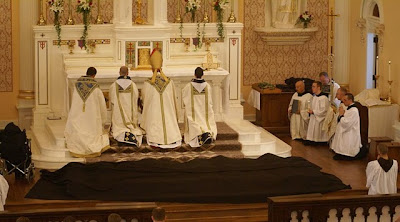
Solemn Profession of the Benedictines of Mary, Queen of Apostles, in Kansas City
Kansas Catholic has FANTASTIC pictures of the Solemn Profession of Vows of the
Click on Kansas Catholic above to see all of the pictures, and make sure to see all four parts.
Below are just of few of the incredible photos...



Friday, May 14, 2010
Tuesday, March 2, 2010
Franciscan Friars of the Renewal Novitiate Class of 2010

The Franciscan Friars of the Renewal 10 New Novices - 2010:
(l-r) Fr. Glenn Sudano, novice master; Br. Frantisek Marie Chloupek, Br. Vittorio Maria Pesce; Br. Jude Thaddeus Boyden; Br. Tobias Marie Redfield; Br. Simeon Mary Lewis; Fr. Maximilian Mary McGoldrick; Br. Seámus Mary Laracy; Br. Mark-Mary Maximilian Ames; Br. Angelus Immaculata Montgomery; Fr. Felipe Immaculée Casadia; and Fr. Mariusz Koch, community servant.
Thursday, January 14, 2010
"Vocations are Still a “Super-Priority”"
 From The Catholic Key
By Bishop Robert W. Finn
Kansas City-St. Joseph
In my first months as bishop of the diocese I said Vocations were a “Super Priority.” While we have had a meaningful increase in vocations to priesthood, the diaconate, and some new vocations to consecrated life, I still offer this intention for more vocations to priesthood and Consecrated Life with fervor in my daily prayer. I hope you do also.
We are reaching the midpoint of the Year for Priests, inaugurated by Pope Benedict XVI last June. How proud I am of our priests who do so much for you, God’s people. Still, they need more help, particularly as the pastoral needs seem always to increase. This year, please God, we will ordain four new priests; and it remains possible that in 2012 we could celebrate the ordination of eight or nine new priests at once. I haven’t figured out how we will get everyone in the Cathedral; a pleasing dilemma!
Am I greedy to suggest that we need more priests? I believe that God is calling more men to this wonderful vocation, and we have to listen carefully and prepare well so that your sons can hear and answer that call.
What kind of life awaits the priest? To be sure, there are many joys, and also challenges. The priest is helped by God to give himself to many people. He shares in the greatest joys of people’s lives and is with them in times of hardship and sorrow. He is a pastor, a shepherd, a teacher, and spiritual father. He stands in the place of Jesus Christ, particularly in the Sacrifice of the Mass and in the Sacrament of Reconciliation.
How does a man discern a possible vocation to priesthood? The healthy man (healthy in body, mind and soul), as he matures, wants to give himself in an honest and generous way. It is important and normal that he sees the beauty of marriage, and its central meaning and purpose in society. At the same time, he realizes he has a spiritual dimension to his life and he wants to listen to the promptings of the Holy Spirit and follow God’s call wherever it may take him. He works hard at every task before him, and finds joy in generously reaching out to others. He studies with zeal. He prays. He establishes caring friendships, and determines to live a moral life, growing in the frequent reception of the sacraments, particularly of Confession and Holy Eucharist.
As a man experiences this spiritual depth to his life, he does not seek a vocation that makes him materially rich or famous. Instead, having realized something of the cost and demands of authentic human love, he is ready to trust God and give himself to others out of love for God. He realizes that the Father in heaven has loved him a lot, and the awareness of this love and mercy makes him want to follow God’s plan in his life. Our seminarians are responding to this vocation to the priesthood. Our priests are living this out with dedication. Keep praying for them to persevere.
The role and support of parents is very important to those who are discerning God’s call. Your sons (and daughters) look up to you for approval. They should. Your love for them is unconditional and unselfish. I do not suggest that you should urge your sons to go to seminary, but pray for them, that they do whatever God wants for them. Support them in their search. I pledge once again to our parents that if we receive their sons as our seminarians we will do all in our power to see they get good formation.
Over the course of my priesthood, I have also had occasion to meet many outstanding men and women Religious. I was taught by and have worked closely with several Orders of Religious Women. There is a real renewal taking place in these vocations today. I have established an office for Consecrated Life, and we stand ready to direct young women and men who may be drawn to Religious life as priests, sisters or brothers.
Wednesday, January 13, 2010
Family the Focus of US Vocations Week
 Click HERE to visit Vatican Radio website and listen to audio file of an interview with Fr. David Toups, director of the Secretariat of Clergy, Consecrated Life and Vocations at the US Conference of Catholic Bishops, discuss obstacles to the promotion of vocations in the US. (look for small speaker icon at the end of the paragraph)
Saturday, January 9, 2010
Monday, October 19, 2009
Thursday, October 8, 2009
"Big guns in the spiritual warfare"
 From CatholicCulture.org
By Phil Lawler
If you've ever spent autumn in New England, you know about the "leaf peepers"-- the tourists who flock to Vermont to enjoy the foliage in early October. But early October-- and specifically this day: October 6, the feast of St. Bruno-- bring different memories of Vermont for me.
Back in 2001 I had a truly unique experience. I was invited by the Carthusians of Arlington, Vermont, to spend a day with them and write a story about their way of life. They were celebrating the 900th anniversary of the death of St. Bruno, the founder of the Carthusian order, and decided that it was an appropriate time for a bit of publicity.
I say that my experience was unique because Carthusians generally don't seek publicity-- to put it mildly. Theirs is the strictest, most ascetical order in the Catholic Church. The monks live in silence, utterly withdrawn from the world. When I commented to the prior on the oddity of a Carthusian "publicity campaign," he remarked that he could perhaps imagine another opportunity for a journalist to visit the Charterhouse in Vermont-- in another 100 years, to celebrate St. Bruno's 1,000th anniversary!
For that one day in 2001, at the monastery hidden near the top of Mt. Equinox, I had a glimpse of a totally different kind of life: a life devoted utterly to prayer and contemplation. When a man enters the Carthusian order, in a real sense he leaves the world in which you and I live. He gives up normal food, social life, travel, even speech for the rest of his days. Barring medical emergency he will not leave the Charterhouse until his remains are buried there. The Carthusian monk willingly chooses a life sentence, in solitary confinement, to devote himself totally to prayer. These are very, very serious Christian men: seasoned veterans of the spiritual combat.
Very few Christians are called to such an austere life. Most of us live ostensibly ordinary lives, absorbing a daily drubbing from the secular world. But we're engaged in spiritual combat as well. In fact we lay people are the infantry.
There are days when the skirmishing is rougher than usual, when I feel exhausted and bedraggled. Those are the days when I remind myself that while we're not alone. While we're grappling on the front lines, the big guns are booming from Mt. Equinox. Those are the days when I'm struck anew by the amazing diversity of vocations within the Church, and I thank God for my silent friends at the Charterhouse.
Wednesday, September 30, 2009
Foundations of Religious Life
The Council of Major Superiors of Women Religious has maintained the historical form of religious life, with sisters living in community and wearing the habit. While many religious orders are currently facing marked decline in novitiates and the aging of their members, the communities of the CMSWR are experiencing growth on a worldwide scale.In this collection of foundational articles, the CMSWR articulates how its perspective is in keeping with the vision set forth by Vatican II, suggesting that its commitment to a more visibly countercultural life and ministry is what sustains its orders and attracts young women to the CMSWR communities. The Foundations of Religious Life is ideal reading for sisters and those in formation, as well as their counterparts in men's communities.
Tuesday, September 29, 2009
Pope Benedict's Address to Youth in the Czech Republic
STARA BOLESLAV, Czech Republic, SEPT. 28, 2009 (Zenit.org).- Below is the text of the address Benedict XVI gave today when he met with youth on the final day of his visit to the Czech Republic.
Dear Young Friends,
At the conclusion of this celebration I turn to you directly and I greet you warmly. You have come here in great numbers from all over the country and from neighbouring countries; you camped here yesterday evening and you spent the night in tents, sharing an experience of faith and companionship. Thank you for your presence here, which gives me a sense of the enthusiasm and generosity so characteristic of youth. Being with you makes the Pope feel young! I extend a particular word of thanks to your representative for his words and for the wonderful gift.
Dear friends, it is not hard to see that in every young person there is an aspiration towards happiness, sometimes tinged with anxiety: an aspiration that is often exploited, however, by present-day consumerist society in false and alienating ways. Instead, that longing for happiness must be taken seriously, it demands a true and comprehensive response. At your age, the first major choices are made, choices that can set your lives on a particular course, for better or worse. Unfortunately, many of your contemporaries allow themselves to be led astray by illusory visions of spurious happiness, and then they find themselves sad and alone. Yet there are also many young men and women who seek to transform doctrine into action, as your representative said, so as to give the fullness of meaning to their lives. I invite you all to consider the experience of Saint Augustine, who said that the heart of every person is restless until it finds what it truly seeks. And he discovered that Jesus Christ alone is the answer that can satisfy his and every person's desire for a life of happiness, filled with meaning and value (cf. Confessions, I.1.1).
As he did with Augustine, so the Lord comes to meet each one of you. He knocks at the door of your freedom and asks to be welcomed as a friend. He wants to make you happy, to fill you with humanity and dignity. The Christian faith is this: encounter with Christ, the living Person who gives life a new horizon and thereby a definitive direction. And when the heart of a young person opens up to his divine plans, it is not difficult to recognize and follow his voice. The Lord calls each of us by name, and entrusts to us a specific mission in the Church and in society. Dear young people, be aware that by Baptism you have become children of God and members of his Body, the Church. Jesus constantly renews his invitation to you to be his disciples and his witnesses. Many of you he calls to marriage, and the preparation for this Sacrament constitutes a real vocational journey. Consider seriously the divine call to raise a Christian family, and let your youth be the time in which to build your future with a sense of responsibility. Society needs Christian families, saintly families!
And if the Lord is calling you to follow him in the ministerial priesthood or in the consecrated life, do not hesitate to respond to his invitation. In particular, in this Year of Priests, I appeal to you, young men: be attentive and open to Jesus's call to offer your lives in the service of God and his people. The Church in every country, including this one, needs many holy priests and also persons fully consecrated to the service of Christ, Hope of the world.
Hope! This word, to which I often return, sits particularly well with youth. You, my dear young people, are the hope of the Church! She expects you to become messengers of hope, as happened last year in Australia, during World Youth Day, that great manifestation of youthful faith that I was able to experience personally, and in which some of you took part. Many more of you will be able to come to Madrid in August 2011. I invite you here and now to participate in this great gathering of young people with Christ in the Church.
Dear friends, thank you again for being here and thank you for your gift: the book of photographs recounting the lives of young people in your dioceses. Thank you also for the sign of your solidarity towards the young people of Africa, which you have presented to me. The Pope asks you to live your faith with joy and enthusiasm; to grow in unity among yourselves and with Christ; to pray and to be diligent in frequenting the sacraments, especially the Eucharist and Confession; to take seriously your Christian formation, remaining ever obedient to the teachings of your Pastors. May Saint Wenceslaus guide you along this path through his example and his intercession, and may you always enjoy the protection of the Virgin Mary, Mother of Jesus and our Mother. I bless all of you with affection!
Dear Young Friends,
At the conclusion of this celebration I turn to you directly and I greet you warmly. You have come here in great numbers from all over the country and from neighbouring countries; you camped here yesterday evening and you spent the night in tents, sharing an experience of faith and companionship. Thank you for your presence here, which gives me a sense of the enthusiasm and generosity so characteristic of youth. Being with you makes the Pope feel young! I extend a particular word of thanks to your representative for his words and for the wonderful gift.
Dear friends, it is not hard to see that in every young person there is an aspiration towards happiness, sometimes tinged with anxiety: an aspiration that is often exploited, however, by present-day consumerist society in false and alienating ways. Instead, that longing for happiness must be taken seriously, it demands a true and comprehensive response. At your age, the first major choices are made, choices that can set your lives on a particular course, for better or worse. Unfortunately, many of your contemporaries allow themselves to be led astray by illusory visions of spurious happiness, and then they find themselves sad and alone. Yet there are also many young men and women who seek to transform doctrine into action, as your representative said, so as to give the fullness of meaning to their lives. I invite you all to consider the experience of Saint Augustine, who said that the heart of every person is restless until it finds what it truly seeks. And he discovered that Jesus Christ alone is the answer that can satisfy his and every person's desire for a life of happiness, filled with meaning and value (cf. Confessions, I.1.1).
As he did with Augustine, so the Lord comes to meet each one of you. He knocks at the door of your freedom and asks to be welcomed as a friend. He wants to make you happy, to fill you with humanity and dignity. The Christian faith is this: encounter with Christ, the living Person who gives life a new horizon and thereby a definitive direction. And when the heart of a young person opens up to his divine plans, it is not difficult to recognize and follow his voice. The Lord calls each of us by name, and entrusts to us a specific mission in the Church and in society. Dear young people, be aware that by Baptism you have become children of God and members of his Body, the Church. Jesus constantly renews his invitation to you to be his disciples and his witnesses. Many of you he calls to marriage, and the preparation for this Sacrament constitutes a real vocational journey. Consider seriously the divine call to raise a Christian family, and let your youth be the time in which to build your future with a sense of responsibility. Society needs Christian families, saintly families!
And if the Lord is calling you to follow him in the ministerial priesthood or in the consecrated life, do not hesitate to respond to his invitation. In particular, in this Year of Priests, I appeal to you, young men: be attentive and open to Jesus's call to offer your lives in the service of God and his people. The Church in every country, including this one, needs many holy priests and also persons fully consecrated to the service of Christ, Hope of the world.
Hope! This word, to which I often return, sits particularly well with youth. You, my dear young people, are the hope of the Church! She expects you to become messengers of hope, as happened last year in Australia, during World Youth Day, that great manifestation of youthful faith that I was able to experience personally, and in which some of you took part. Many more of you will be able to come to Madrid in August 2011. I invite you here and now to participate in this great gathering of young people with Christ in the Church.
Dear friends, thank you again for being here and thank you for your gift: the book of photographs recounting the lives of young people in your dioceses. Thank you also for the sign of your solidarity towards the young people of Africa, which you have presented to me. The Pope asks you to live your faith with joy and enthusiasm; to grow in unity among yourselves and with Christ; to pray and to be diligent in frequenting the sacraments, especially the Eucharist and Confession; to take seriously your Christian formation, remaining ever obedient to the teachings of your Pastors. May Saint Wenceslaus guide you along this path through his example and his intercession, and may you always enjoy the protection of the Virgin Mary, Mother of Jesus and our Mother. I bless all of you with affection!
Tuesday, September 22, 2009
USSCB site hosts pictures of class of 2009 Priests

Click on the image above to see the Ordianation Class of 2009!
Subscribe to:
Posts (Atom)


 Posts
Posts