If you are actively discerning a vocation to the Priesthood, Diaconate, Consecrated Life, or Marriage and you are looking for information to help in your discernment, BE SURE TO CHECK the section at the bottom of the right sidebar for the "labels" on all posts. By clicking on one of these labels it will take you to a page with all posts containing that subject. You will also find many links for suggested reading near the bottom of the right sidebar. Best wishes and be assured of my daily prayers for your discernment.

Saturday, March 15, 2008

"Diocesan priest community established in Denver"

Denver, Mar 15, 2008 / 01:53 am (CNA).

In response to a call from Vatican II for priests to share a common life, four seminarians for the Archdiocese of Denver have decided to begin a priestly community that will eventually be opened up to any priest or seminarian in the archdiocese.

Currently, the Companions of Christ is an association of seminarians established in the Archdiocese of Denver. Once the four founding men are ordained, they will live together as priests in a rectory close to their pastoral assignments in the Archdiocese of Denver.

The priests will strive to live with three emphases: “Observance of the evangelical counsels in the context of the diocesan priesthood, commitment to a common life of prayer and fraternity, and dedication to the New Evangelization, including catechesis, spiritual renewal, and the fostering of vocations,” according to their website.

The Companions of Christ have already received the blessing of the Archbishop of Denver, Charles Chaput who established the fraternity “canonically” on December 12, 2007, the feast of Our Lady of Guadalupe.

“Our priests today face immense challenges: larger parishes, fewer priests to assist them, and a more secular culture that is at times hostile to both the Gospel and the priesthood,” said the archbishop. “Grouped in rectories in various parts of the Archdiocese, they strive together for the ideal of the priesthood, giving mutual support and holding each other to a strict accountability.”

Noting the difficulties priests face, Father Michael Glenn, Rector of St. John Vianney Theological Seminary added, “All priests want to live a committed and zealous life, but the demands of ministry, human weakness and the difficulty of their work can often discourage them, revealing a life far different than what he expected while in the seminary.”

The Companions of Christ will directly address the problems priests are currently facing and will offer encouragement. “Fraternal life offers unity in prayer and identity, as well as strength and support for Christ’s mission. God has truly blessed us with a model of life that will help Companion Priests and many others to be holy, joyful, and healthy shepherds in their service and leadership of God’s people. Nothing promotes vocations, invites to prayer, or enlivens a parish more than dynamic, fulfilled priests who love the life they live. Strengthened as brothers in Christ, priests are ready to step forward in leadership for the New Evangelization.”

Companions of Christ is comprised of four Denver seminarians: John Nepil, Matt Book, Brian Larkin, and Mike Rapp who will be ordained in the next two or three years.

Plans for the group began after one seminarian learned about a similar community in St. Paul, Minnesota. The seminarians there “insisted that it wasn’t a new idea, just something that had been lost, that the Church was seeking to recover.”

After years of prayer, three other seminarians were drawn to the idea of the fraternity. “The four men spent the next year together quietly praying and sharing meals, all the while fully immersed in the life of St. John Vianney Theological Seminary.”

Since the announcement of the community, the Companions of Christ have been received with support and encouragement.

"Summorum Pontificum" in the Seminary

From ZENIT:

Cardinal Rigali on Introducing Seminarians to the 1962 Missal

By Annamarie Adkins

PHILADELPHIA, MARCH 14, 2008 (Zenit.org).- Since Benedict XVI has said that the Mass celebrated according to the 1962 Roman Missal promulgated by Blessed John XXIII should be available to those who prefer it, seminarians should be taught to say it, says Cardinal Justin Rigali.

The Pope clarified in his apostolic letter "Summorum Pontificum" that there are two forms of the liturgy in the Roman Rite of the Catholic Church: ordinary and extraordinary.

To learn what some bishops are doing to implement the document in seminaries, ZENIT spoke with Cardinal Rigali, archbishop of Philadelphia, about his plans to introduce seminarians at St. Charles Borromeo Seminary to the extraordinary form of the Mass.

Cardinal Rigali also suggested why priests already in active ministry should become familiar with the Missal of 1962.

Q: What practical steps are being taken to incorporate "Summorum Pontificum" into the life and curriculum of the seminary?

Cardinal Rigali: First there will be a lecture offered on the "motu proprio" that elucidates the theology underlying the 1962 missal so that the seminarians are afforded a clear understanding of the "motu proprio" and the Holy Father's pastoral concern for the faithful who have a deep love for the Tridentine liturgy.

Since nearly all of the seminarians at St. Charles Borromeo Seminary have grown up attending Mass according to the "Novus Ordo" -- Missal of Paul VI -- it is important to offer an exposition of the Mass according to the 1962 missal -- Missal of Blessed John XXIII.

Further, seminary course work in theology, liturgy and Church history will cover and expound upon the Holy Father's initiative. It will be helpful for them to see the continuity between the two expressions, but will also afford the opportunity to address the changes that took place in the liturgy following the Second Vatican Council.

Sometime in the spring semester, after the lecture, Holy Mass according to the extraordinary form will be celebrated once for the entire St. Charles Borromeo Seminary community. This will demonstrate to the seminarians the liturgically correct manner in which the extraordinary form of the Mass is to be celebrated.

Q: What about "Summorum Pontificum" has led you to support the incorporation of that document into the life of St. Charles Borromeo seminary? Are you foreseeing a greater demand for the traditional form of the Mass in the future?

Cardinal Rigali: The Holy Father has indicated that the Mass according to the extraordinary form as well as celebration of the sacraments should be available to the faithful when there is a genuine pastoral need.

Many of our clergy have never celebrated Mass or administered the sacraments according to the 1962 missal and the other liturgical texts. In order to provide for the pastoral needs, should they arise, the current seminarians should have the opportunity to be properly educated as to the rituals involved and the theology that underlies these forms.

At present I do not foresee a great demand for celebrations according to the extraordinary form of the Mass. In the Archdiocese of Philadelphia the requests we have received are very few. Most Catholics today find spiritual satisfaction in the Mass as celebrated using the Missal of Paul VI, and this remains the ordinary form of the celebration.

This being said, we are blessed to have two parishes in different areas of the archdiocese that celebrate Mass in the extraordinary form, who had already for some time been offering Mass with the Tridentine Missal by grant of the necessary indult. I am grateful that these parishes provide for the spiritual and pastoral needs of those faithful who prefer the extraordinary form.

Q: Some analysts of "Summorum Pontificum" have said that it is primarily directed at priests, and is a gift to them. What is your view?

Cardinal Rigali: The "motu proprio" is issued by the Holy Father for all Catholics.

With regard to priests, any statement from the Holy Father on the liturgy or any change in the liturgical forms or formula afford the priests an opportunity for thought and reflection on the mysteries they celebrate in the liturgy.

Many priests find in these opportunities a renewed sense of awe and appreciation for the liturgy and an opportunity for recommitment to celebrate these liturgies in a more reflective, reverent and respectful manner.

In this sense, "Summorum Pontificum" is a gift to all priests, because it encourages them, through the sacred liturgy, to draw all people into a deeper communion of holiness with the Lord.

Q: Seminaries are in the business of formation, particularly liturgical formation. What formative effect do you believe learning and celebrating the extraordinary form of the Mass will have upon seminarians?

Cardinal Rigali: Studying about and learning the Mass according to the 1962 Missal will afford the seminarians an opportunity to experience the continuity between the older and newer forms.

So much of our faith is based on continuity and tradition, handing on of the faith from one generation to the next. Sometimes the rituals change and develop but at the core they remain the same.

Benedict XVI stated in his letter to the bishops that accompanied the "motu proprio," "There is no contradiction between the two editions of the Roman Missal. In the history of the liturgy there is growth and progress, but no rupture. What earlier generations held as sacred, remains sacred and great for us too, and it cannot be of all of a sudden entirely forbidden or even considered harmful. It behooves all of us to preserve the riches that have developed in the Church's faith and prayer, and to give them their proper place."

The liturgical training St. Charles Borromeo seminarians receive forms them in reverence and holiness, which in turn will serve the faithful to whom they will minister once they are ordained.

Q: Will saying Mass according to the Missal of Blessed John XXIII affect the way a priest says the "Novus Ordo" Mass?

Cardinal Rigali: Any priest who is unfamiliar with the extraordinary form, or who has not celebrated the liturgy according to this form for some time, will probably, and quite naturally, reflect on the manner in which he celebrates Mass according to the "Novus Ordo."

Such a reflection is positive because it cannot help but lead to a more reverent and worthy celebration of the liturgy.

Q: What can priests do to incorporate "Summorum Pontificum" into their own priestly ministry?

Cardinal Rigali: St. Charles Borromeo Seminary is offering a course for priests who wish to be educated and trained in the proper celebration of the Mass according to the Missal of Blessed John XXIII to ensure competence in the Latin language and the rubrics of the extraordinary form.

Prior to engaging a "practicum" experience, the theology behind the liturgy and the "motu proprio" will be studied. I have encouraged any priest who may wish to learn to celebrate this liturgy to seek such educational opportunities so that the liturgy may be celebrated in a prayerful and reverent manner.

Thursday, March 13, 2008

Priests hope Pope Benedict visit inspires vocations

From Detroit Free Press

BY GARY STERN • WESTCHESTER JOURNAL NEWS • March11, 2008

When Pope Benedict XVI addresses 20,000 youths at St. Joseph's Seminary in Yonkers, N.Y., and 60,000 people at Yankee Stadium next month, many priests will be crossing their fingers that the pontiff urges -- demands, even -- that young Catholic men consider a collar.

Like the Detroit area, the Archdiocese of New York is in serious need of new priests. Of the 176 Catholic dioceses in the U.S., the Archdiocese of New York ranks 170th in terms of the ratio of seminarians to the total Catholic population, according to a December study by Catholic World Report.

Detroit also ranked in the bottom 20 in the report, but unlike New York, will not be receiving a papal visit.

Right now the main seminary at St. Joseph's is preparing only 23 seminarians for possible ordination as diocesan priests over the next four years.

And not a single man is scheduled to enter the seminary program next fall.

Bishop Gerald Walsh, rector of St. Joseph's, said that the absence of a freshman class could be a good thing if it forces New York's Catholic community to face the dire need for priests.

"It is a wake-up call," Walsh said. "We have to do something. I'm a believer that difficulties can be opportunities, not disasters. It depends on what you do with them."

The hope is that the visit by Pope Benedict will inspire young men to listen for God's call to the priesthood and rouse Catholic families to mention the priesthood around the dinner table.

"His mission is really to encourage us in the faith, to strengthen us in our belief and commitment to Jesus Christ, make us better disciples," said the Rev. Luke Sweeney, vocations director for the archdiocese. "If he does that and that alone, vocations will come from it."

But Sweeney hopes the pope will go a step farther when he's speaking directly to New Yorkers.

"I presume that the Holy Father will make an appeal to some of them, to say that God wants you to be priests," he said. "That, coming from the pope, will mean a world of difference to young people."

Nationally, the number of diocesan priests dropped from 36,000 in 1975 to 28,000 last year. But the number of seminarians, after falling sharply since the 1960s, rebounded in the last decade to 3,300.

In big-city archdioceses like Detroit, the seriousness of the shortage tends to be hidden because priests just work harder and longer, even though they are more isolated than ever before, said Dean Hoge, a professor of sociology at the Catholic University of America in Washington, D.C.

"You can muddle through with one priest for many, many Catholics," said Hoge, a leading expert on the priest shortage. "But it's still a monster problem. There is no way we can continue to go ahead much longer with parish life as we know it when there are so few priests and so many Catholics."

Many insist that the frenetic pace of modern life, combined with a growing social emphasis on individualism and secularism, may discourage young men from listening.

"I think the odds are stacked against us in the age in which we live, more than in any other age," said Brian Graebe, 27, from Staten Island, a first-year student at St. Joseph's. "We have a tough battle. How do we counter all of these trends that are working against this timeless message, this august call to the priesthood? The message is there, it's strong, it speaks for itself. We just have to allow them to hear it."

New York's Irish community has provided the vast majority of parish priests for 200 years. Part of the problem facing the archdiocese is that an estimated 40% to 50% of Catholic New Yorkers are Hispanic, but Hispanic communities are not producing priests.

Dominican-born Alex Reyes, 24, of the Bronx, a third-year seminarian, said many Hispanic young men told him they might be interested in becoming priests if not for one thing.

"I know a lot of young Hispanic guys who are very interested in the priesthood, but to tell you the truth, the big problem is celibacy," Reyes said. "That is the main reason they hold off."

This is where Pope Benedict comes in. He is visiting the U.S., in part, to inspire the faithful.

The Rev. Michael Morris, professor of church history at St. Joseph's, said he was among many seminarians during the 1980s who became sure of their call after Pope John Paul II's visit in 1979.

"I discovered when I got to seminary, that I wasn't alone," he said. "Other guys felt the same way that I did. Hopefully, this will happen as a result of this papal visit. Hopefully we'll be filled again someday."

U.S. Dominican nuns turn heads, spread God's love to youths in Sydney

By Dan McAloon
Catholic News Service

SYDNEY, Australia (CNS) -- Everywhere they go in Sydney, the three Dominican nuns from Tennessee keep turning heads. Dressed in their distinctive white habits and black and white veils, the sisters stand out in the crowd.

At Sydney Harbor, where the tourists fix their cameras on the iconic Opera House and bridge, the arrival of Sisters Anna Wray, Mary Rachel Capets and Mary Madeline Todd gets everybody's viewfinders swinging in their direction.

The reaction of local residents in Belmore, the multicultural suburb where they are staying, is similar. The Vietnamese baker and his wife tell them of the kindness of Catholic nuns to war orphans in their homeland. The older people in the street stop to reminisce about the nuns who taught them at school. The "hijab"-wearing Muslim women, at first surprised at the sight of the nuns' veils, smile broadly with the recognition of the love of a common God.

"You're making our neighborhood a different place," the Lebanese shopkeeper told them. And when his customers ask if he has seen the strange new nuns about, the shopkeeper boasts: "Yes, of course! They are my friends!"

The nuns are in Sydney at the invitation of Sydney Auxiliary Bishop Anthony Fisher, World Youth Day 2008 coordinator and fellow Dominican. Normally they would be at home teaching, but their motherhouse in Nashville has sent delegations to assist with preparations for each World Youth Day since Denver was the host city in 1993.

"It's part of our apostolic mission to spread God's love to the youth of the world," said Sister Anna, 28, noting that as Dominicans their lives are balanced between "contemplation and action."

"Wherever we are, we live by our values. Our founder Dominic was about taking God's word into the world and influencing people. We have a capacity to be adaptive, you could say. We know that people won't listen to us unless we are clearly living what we preach," she said.

A colleague at the Sydney Archdiocese describes the three as a "breath of fresh air about the place."

While Sister Mary Madeline is working as an assistant to Bishop Fisher, Sister Anna works with the liturgical committee and Sister Mary Rachel helps plan the youth festival.

As the July 15-20 World Youth Day events approach, there are still myriad details to be finalized in time for the arrival of the pilgrims. More than 125,000 are expected to arrive from overseas for the event, including 38,000 from the United States.

Sister Mary Rachel, 32, said that despite the 20-hour flight from Los Angeles, pilgrims from the U.S. won't be disappointed.

"They will find a beautiful, friendly city. People here are very generous because many are migrants and they know what it is to be the stranger," she said. "And for the pilgrims there's the special grace of being in the presence of the pope and in experiencing the beauty of the universal church."

"All Catholic life is a pilgrimage, and every experience teaches us something new," added Sister Mary Madeline. "I think the people of Sydney will be very surprised by how many pilgrims are ready to make that journey for Christ and celebrate their life in communion."

Sister Anna, a Dominican novice, has her own pilgrim story to tell of the influence World Youth Day had in calling her to religious life.

"Being in Rome for World Youth Day (in 2000) really was a catalyst for my entering religious life," she said. "I had no intention of being a sister then, but I did hear the offering of the church and the Holy Father, 'Do not be afraid to live the Gospel directly.' And that is something I have tried to do ever since."

As a retired nun turns 100, she reflects on her years of devotion to God, others

By Sophia Rodriguez
The Post and Courier
Thursday, March 13, 2008

Sister Brendan Lacey has led a full life. She immigrated to the United States in her teens, brought people through medical catastrophes as a nurse, helped bring life into the world, and developed a close and deeply personal relationship with God.

She has a lifetime of memories to draw upon, and a few days before her 100th birthday are just as good a time as any to reflect on them.

"All life is what you make of it," she said, sitting in the parlor of the Sisters of Charity of Our Lady of Mercy convent on Fort Johnson Road, her hands folded serenely in her lap and a slight smile on her kind face.

This is one of those life lessons she has learned from her many years on Earth. It all depends how you view your circumstances and what you decide you want out of life. Some may shun the ideals of a Catholic sisterhood, a life void of a spouse, raising a family and pursuing a layman's career as too quaint, too provincial, maybe too boring to seriously consider. But in a way, Lacey has all those things.

Even though she had never considered working as a nurse, she found her way into that field as a result of her pull toward the religious life as a young teenager. Not only does she have other family members in the United States, but she always has had a built-in one at the institutions where she has lived throughout her life. And in a sense, her closeness to God is a marriage: one of love and strong bonds built over the years.

Lacey's story began when she was born as Elizabeth on March 14, 1908, in County Laois, Ireland, about 90 miles southwest of Dublin. She was educated at the National School and then by Mother McAuley's Sisters of Mercy. When she was 13, she started to feel she was being called to serve in a similar capacity as the nuns who were her teachers.

"It was beyond a boarding school," Lacey said. She also was preparing for her future service.

She met two nuns at Our Lady of

Mercy from Charleston. They were vacationing in the beautiful country, but they also had been instructed by the area's bishop at the time, the Most Rev. William T. Russell, to invite young women who were interested in serving in foreign missions to Charleston. The 16-year-old girl took them up on the offer and, along with seven other girls, hopped aboard a ship headed for New York Harbor.

She arrived in 1924, and a few days later, sailed down to Charleston on a Clyde Mallory Line vessel. One of the first noticeable differences she encountered between her homeland and her new land was the temperature jump. The August heat took her by surprise because in comparison, "Ireland is a very cold country." She also had to get used to the Southern drawl. But she didn't feel lost.

"I didn't feel I was in a foreign country because there were four girls here who had come out of school a year before me," she said.

She began her training for the sisterhood, called novitiate, at the motherhouse, which was behind the Cathedral of St. John the Baptist at the time.

"You go through the routine of the day," she said. "You have different times of the day when you pray, and you have different times for meals. You go to bed at a certain time, and wake up at a certain time."

After six months, she received her habit and a new religious name that she got to pick: Brendan.

"I had no other reason than, 'Here is an Irish saint,' " she said.

After that, she entered the standard two years of training. The first year consisted of learning the rules and structure of her new life. She did no outside work and took three vows, that of poverty, chastity and obedience. "We study each one of those vows and what they entail. ... We don't marry, we don't own anything in private and we obey what (the leaders of the convent and church) say."

After that training was over, she entered nurse's training, something she had never considered doing before but agreed to because it was asked of her. She was on the St. Francis Xavier Hospital's staff until 1960, then transferred to Divine Saviour Hospital and Nursing Home in York. She spent three years as the matron of the City Orphan Asylum that was on Queen Street in Charleston, and then returned to Divine Saviour in 1964 and remained there until the early '90s.

Most of those years, she worked as a night supervisor in an active emergency room, treating patients for injuries from car accidents and "things resulting from brawls and fights and things like that."

"I had to accommodate myself to a lot of things, especially OB. You can read about those things, but when you see it, it's a different thing."

She would sleep in the daytime and work 12-hour shifts. It was a happy and educational time. "It gets you into the joys and sorrows of people," she said.

In 1992, she moved to Simpsonville to be a fellow nun's companion. Although she didn't have any assigned work, she found small tasks to occupy her time. She wrote thank-you letters at the St. Mary Magdalene Society to people who asked for Masses to be said for someone or sent money to the church. She stayed there until four years ago, when she retired to her current home at the motherhouse on James Island.

She considers her nursing years as a ministry of service, while her days now are spent in a ministry of prayer. She feels fortunate to have access to daily Mass at Our Lady of Mercy's chapel. Prayer has been the constant thread throughout her years — prayers for families, the community's needs, prayers for people to acquire virtue, prayers for the sick, the deceased, the cessation of war — the list goes on.

"I pray a lot, and that sustains me," she said. "I enjoy the company of the other sisters."

Her pleasures and activities are simple. She doesn't know much about what goes on beyond the convent walls, but she keeps up with newspapers and television broadcasts. She religiously watches Brian Williams on the "NBC Nightly News" even though her eyesight isn't what it used to be.

As for turning the ripe young age of 100?

"Situations make you feel old," she said, gesturing to her walker. "Your body is a good teacher. It tells you what you're capable of and what you're not."

As for the rest of it, "I feel no different in my life than when I was 20. I just know my years are shorter."

"Nun can stop these teachers"


"Nun can stop these teachers"

Parents praise St. Francis school education

By Elizabeth Hardin-Burrola
Staff writer Gallup Independent

GALLUP — For parents like Cindy Vargas, St. Francis of Assisi School is “a little miracle” on West Wilson Avenue.

And for Vargas, much of what makes St. Francis such a good school for Dylan, her son in first grade, are the Catholic sisters who work there as teachers and teacher’s aides.

Vargas was one of three parents who talked with the Independent recently about their appreciation for the sisters and the school. She was joined by Marisa Hutchinson, the mother of sixth-grader Danielle and first-grader Gabriel, and by Mellissa Aparicio, also the mother of a first-grade son named Gabriel.

In light of the much-publicized struggles and failings of the public school system, the three local moms wanted to spotlight some positive attention on what they believe are eight strengths of St. Francis — the four sisters of Our Lady of Guadalupe and St. Joseph from Mexico and the four Rosarian Dominican sisters from the Philippines.

In fact, St. Francis School is even unusual in the Diocese of Gallup because 80 percent of the school’s teachers and teacher’s aides are Catholic sisters. All the other schools in the diocese, like many Catholic schools across the country, have higher numbers of lay teachers because of declining numbers of women entering religious orders over the last several decades. According to Sister Rene Backe, diocesan superintendent of Catholic schools, only two sisters teach at St. Anthony in Zuni and St. Michael Elementary School in Arizona, four are at St. Bonaventure in Thoreau and at St. Michael High School in Arizona, and Sacred Heart in Farmington and St. Joseph in San Fidel only have one sister each. The St. Michael schools also have three religious brothers as teachers.

And unlike many contemporary Catholic sisters who dress similarly to women in the larger society, the sisters at St. Francis are unusual in that their distinctive habits reflect their more traditional and conservative religious orders.

That traditional background seems to reflect what Vargas, Hutchinson, and Aparicio were searching for when they went looking for a school to educate their children.

Vargas, a product of Gallup’s old Cathedral School, was taught by sisters and believes she received a high-quality education.

“I wanted my son to grow up that way,” she said. Vargas said she has been pleased with the academics at St. Francis, adding that her son began reading while enrolled in his pre-K4 class.

Hutchinson and Aparicio, who both moved to Gallup because of their husbands’ jobs, transferred their children to St. Francis after being dissatisfied with their first schools in Gallup. Both mothers said their children tested as gifted but weren’t being academically challenged in their former schools. In contrast, they said, the sisters at St. Francis are good at providing challenging assignments rather than just extra busy work. They have also been pleased with the small class size and the resulting individual attention for each pupil.

According to Mary Peretti, a secretary at the school, St. Francis currently has 100 children enrolled from pre-K3 to sixth grade, with the average class size of 12 pupils. Peretti is somewhat of an authority about St. Francis: she and her siblings attended there up through the eighth grade, she taught there for 18 years, all her children have attended St. Francis, and now her grandchildren are enrolled.

Although not Catholic, Hutchinson said she is also happy with the religious instruction in the school. Originally from Florida, Hutchinson said her church background is with the African Methodist Episcopal Church. Noting that “God has been taken out of everything” in American society, Hutchison said she is OK with her children learning Catholic beliefs and prayers. “It’s still Christianity,” she said.

Vargas and Aparico, who are both Catholic, said they were attracted to the school’s emphasis on faith-based education. “I’m learning things about the Bible that I didn’t even know by reviewing the lessons,” said Aparico.

The women believe that faith-based approach positively influences relationships between pupils and between parents. Through working on classroom projects and school fundraisers, Aparico said she has come to view the other mothers in the school as her sisters. Vargas credited the teachers as fostering that caring atmosphere among parents.

“They bring the quality of compassion and Catholicism,” agreed Principal Mary Ann Frank.

The eight sisters also bring an international flavor to the school. Having teachers from Mexico and the Philippines helps broaden the children’s cultural understanding, said Hutchinson, who added that her daughter has loved performing the traditional Mexican dances she has learned from her teachers.

“They’re in a multi-cultural school,” agreed Aparicio. She said she’s been pleased that her son has been exposed to both Spanish and the Filipino language of Tagalog while in school, and she doesn’t believe the teachers’ foreign accents have hindered Gabriel’s English reading and writing skills.

Other parents in Gallup may not share that same view. According to Frank, a first year principal at St. Francis, some parents have voiced concern about English being the sisters’ second language. Some parents may not consider the school as an educational option because of that factor, she said, and also because of its “across the tracks” location.

An additional challenge the school faces, Frank said, involves the immigration status of the four Filipino sisters. Although the sisters are working in the U.S. legally, she explained, a paperwork snafu from a few years ago is threatening their ability to stay in Gallup. Frank said she hopes someone will be able to help solve the problem before the end of the school year.

Frank expressed appreciation for the parents’ support, particularly the “dogged persistence every month” by those parents who organize fund-raiser after fund-raiser to help support St. Francis. The aging school, which has a lot of maintenance issues, is not funded by either the Diocese of Gallup or the St. Francis parish, she explained, but rather seems to survive on “lots of grace and support.”

"Football priest shocks referee"

As I've said before, priests are human, and sports tend to elicit some deep seeded elements of our humanity.

From Afrik.com:

A footballer priest from Burkina Faso shocked spectators when he angrily threw his shirt at his referee in a match held at the Vatican City. In its efforts to curb football violence in Italy and to give the game a positive facelift, Italian sports officials hope the clericius Cup – an international football tournament including Catholic priests and seminarians – sets an example. Paul the Apostle’s College (where the priest played) was eliminated due to the priest’s actions. (Monday 10 March - 16:28)

Catholic Blog Awards

Less than a week left to vote! Roman Catholic Vocations is in the top 10 of two of the five categories in which it is nominated for a Catholic Blog Award. If you haven't had a chance to cast a vote, please do so before Monday, March 17th -it would be greatly appreciated!

Monday, March 10, 2008

11-year-olds, 11th-graders focus on vocations for a day

Looking to his classmates for guidance, Stephen Sturtevant of Sacred Heart Interparochial School in Pinellas Park tries to match religious men and women with their previous professions during an activity. JANET SHELTON FC

More than 1,000 youths and teens attended this year’s Focus 11 the week of Feb. 11 at St. Lawrence Parish, Tampa.

JANET SHELTON FLORIDA CATHOLIC

TAMPA Church vocation directors say a crucial element of encouraging vocations is inviting young people to consider entering the priesthood or religious life. Focus 11, an annual diocesan vocations rally, ensures at least two groups of Catholic youths get at least one high-energy invitation.

Focus 11 is aimed at students in grades six (or about age 11), and grade 11. Studies show these are the times when adolescents and teens most think about their future life and work. The church believes it is the perfect time to ask them to consider their vocation: what God wants them to do in their lives.

More than 1,000 youths and teens attended this year’s Focus 11 the week of Feb. 11 at St. Lawrence Parish, Tampa. One day was dedicated to high school juniors; the other two were divided between sixth-grade students.

Feb. 12 belonged to about 550 sixth-graders, most from Pinellas County. Over the course of the day they competed for the loudest, most-spirited cheer; sang songs; watched Spiderman clips and humorous skits; and played scavenger hunts that allowed them to meet sisters, brothers and priests from about a dozen religious communities.

Keynote presenter Sister Tracey Dugas, a Daughter of St. Paul stationed in Miami, told the students her big goal as a teen was to get a job at the mall so she could “get a really good discount at The Gap.” A spiritual retreat took her in a different direction. She went from caring about clothes to caring about serving Jesus.

“I realized religion was more about having a relationship with Jesus,” she said. “Focus 11 is about your looking into the future and saying, ‘what kind of person do I want to be?’”

Diocesan schools dedicate an entire school day to the rally. The chairwoman, Poor Clare Sister Phyllis Shaughnessy, who also chairs the diocese’s Clergy and Religious Promotion Commission, said students from public schools, home-schooled children and students of Catholic schools not overseen by the diocese also attended this year.

In addition to inviting teens and preteens to consider a church vocation, Focus 11 encourages those who do not feel the call to support those who do. It isn’t easy for those contemplating the priesthood or religious life, organizers said, because society in general touts self-indulgence, affluence and prestige.

“To go to the seminary today is a lot harder than 20 years ago,” said diocesan Vocations Director Father Len Plazewski. “There’s society, peer pressure. … Guys who go to the seminary today, they really are making a heroic decision.”

Another barrier is parents who harbor negative views of a church vocation, he said. Without thinking, moms and dads say things about the priesthood they would never say about other professions, or make comments that lead children to believe they aren’t “good enough” to hand their life over to God. Some parents feel the religious life is less joyful than what one could have as a married person or parent. Others are downright hostile.

“I can say without a doubt that the No. 1 challenge in vocations is parents,” the priest said. “Even parents who might not object may say subtle things like, ‘that’s a hard life,’ as opposed to saying something (similar) about a doctor. … There’s this (image) of a priest as having a sad and lonely life.”

St. Raphael Catholic School student Cody Hesson said he’s not interested in becoming a priest, but figures his mom would probably be OK with it. His classmate Jason Wacker said his parents would likely say something along the lines of, “Yeah. Right.”

Days before Focus 11, Jennifer Crumley of St. Paul Catholic School in St. Petersburg came home and talked to her mom about the possibility of becoming a religious sister. Amy Crumbley admitted to a less-than-supportive response.

“I told her I wanted grandchildren,” she said.

Father Plazewski said it’s natural for parents to want for their children what has made the parents happy or would have made the parents happy. But moms and dads should be aware that an underlying selfishness could be at play, he said.

“(It could be) ‘I want grandchildren,’ or ‘I want them to make a certain amount of money so they can take care of me when I’m older,’” the priest said.

When young men and women do pursue a church vocation, disapproval usually dissolves when parents see their sons and daughters find happiness. However, getting to that point takes perseverance by the young man or woman. Society and family often work against a call from God, and there are no easy solutions.

“That’s why it’s important to pray for vocations,” Father Plazewski said. “Because it does take courage to say, ‘I’m going to seek this out.’”

Shelton is interim St. Petersburg diocesan editor for the Florida Catholic.

Sunday, March 9, 2008

Explaining priesthood's call

A priest with Tampa Bay area roots is the author of a book on challenges facing the clergy today.
By Waveney Ann Moore

Published March 9, 2008

Acknowledging the challenges facing the contemporary church, Father David Toups, a homegrown Roman Catholic priest now based in the nation's capital, has written a book to bolster fellow priests, men studying for the vocation, and by extension, all of the faithful.

The author of Reclaiming Our Priestly Character is a graduate of Clearwater Central Catholic High School. He was ordained at the Cathedral of St. Jude the Apostle in 1997 and until recently was dean of students at St. Vincent de Paul Regional Seminary in Boynton Beach.

Now associate director of the Secretariat of Clergy, Consecrated Life and Vocations for the United States Conference of Catholic Bishops, Toups, 36, is optimistic about the future of the priesthood and the Catholic Church.

This spring Toups will provide "color" commentary for Pope Benedict XVI's visit to Washington, D.C., from April 15 to 17, on the United States Conference of Catholic Bishops' Web site, which will be featuring a live feed of the pontiff's entire visit to the United States.

Toups' book, an expansion of his doctoral dissertation in Rome, where he studied for seven years, is dedicated to his late father, Leon Toups. His father was a well-known supporter of vocations in the Diocese of St. Petersburg. His mother, Lynn, lives in Largo. Last week, Toups spoke by telephone about his book.

Please discuss your book's timing.

The timing follows Pope John Paul II's pontificate, who certainly was a man who called priests to know who they are and to not be afraid to say that we are called to be different. That doesn't mean we are better. Certainly, following the 2002 outbreak of scandals and in a day and age of fewer priests, this book is meant to be part of the solution, giving us the tools to be renewed in our own lives and also to regenerate the priesthood by joyfully living the vocation that Jesus has called us to.

What is the Roman Catholic Church's view of the unique nature of its priests?

The unique gift of the priesthood in the Catholic Church is the fact that it is an institution which began with Christ and the 12 apostles - his first priests - and through the laying on of hands, or ordination, that unique gift has been transmitted in the Catholic Church for 2,000 years. The priest who participates in the very priesthood of Jesus Christ makes present Jesus to the holy people of God as he celebrates the sacraments for them.

In your book, you write about the different understandings of the priestly role among those ordained before Vatican II and priests ordained after the historic council. How have each of these differing perceptions affected the priesthood and is either correct on its own, or should the understanding be a combination of both?

The question is really about confusion that happened after the Second Vatican Council amongst the priests and laity. The council highlighted in a particular way the priesthood of all of the faithful, which is a beautiful doctrine for the church in which all of the baptized offer the sacrifice of their lives. However, this highlighting of the doctrine of the priesthood of the baptized in some venues obscured the ministerial priesthood which offers to the faithful the holy sacrifice of the Mass in a particular way. And especially highlighted in that era in the late '60s, early '70s, we lived in an egalitarian age in which differences were shunned and hierarchy and discipline were regarded as obsolete. What really the Second Vatican Council simply wanted to do was highlight the beauty and the dignity of the vocation of all of the laity and the vocation of our ministerial priests. Reclaiming our priestly character is about affirming the dignity of both Christian callings.

You say "priests need to be proud of who they are and who they represent." What are the challenges of being a priest today, with relation to the recent sex scandals, fewer men responding to the call and, as a consequence, expanding responsibilities?

It's a great challenge being a priest today, but challenge takes men of heroic virtue to respond to the call of our times. Our priests working in the parishes certainly find themselves very busy fulfilling the duties of their parishes. All the more it is important to foster an interior life of prayer so as not to fall into the trap of functionalism in the priesthood.

You outline coping mechanisms, or as you say, "a plan of living a happy, healthy and holy priesthood." Could you talk about this plan?

First and foremost, one's spiritual life has to be a priority, so daily Mass and Liturgy of the Hours - prayers priests say five times a day - are important. We pray because as Pope John Paul II said, "As we do the work of the Lord, we don't forget the Lord of the work.' Secondarily, one must foster healthy holy relationships with brother priests, with friends and family. ... And also, one must pay attention to one's physical life. That's part of finding balance in life - a healthy diet, good sleep, some exercise. Lastly, there's ongoing formation, which is part of the call to keep ourselves and our 'skills' sharp. Study really fosters one's soul, one's intellect."

What do you mean when you say that a seminarian "lacking a deep desire for marriage and children needs to rethink his vocation?" Couldn't such a desire lead to frustration and problems with retention?

A priest truly is a spiritual father to the people of God. And a priest truly is wedded to the church, so the deepest need of a man to be father and spouse in the deepest sense are met by faithfully fulfilling one's life as a priest. The greatest joy of the priest is what joy we find in being spiritual fathers, of being present to families in their need, of feeding them, the joys of really entering into the hearts of people in their joys and sorrows. It is such a privileged position that we are invited into. It's a grave responsibility that we have to not violate the sanctuary of people's hearts. The vast majority of our priests have been faithful. It takes a man's man to become a priest today. It's not for the faint of heart.

Hope in the Future

The article below, from today's New York Times, is about a beautiful new chapel being built at St. Anthony's High School on Long Island. Br. Gary Cregan, OSF, the principal at St. Anthony's, used to be the Assistant Principal at the High School in Raleigh were I taught. I could write at length about Brother Gary and the influence he has been on thousands of lives (including my own), and their discernment of vocations. While the article isn't directly about vocations, I think you will agree that a chapel like this, and a sense of the transcendent in our faith can only help students to contemplate God's will for their lives. (emphases and comments mine)

A Design to Set Thoughts Aloft

By VALERIE COTSALAS


New York Times
Published: March 9, 2008

BROTHER GARY CREGAN, a Franciscan friar and the principal of St. Anthony’s High School here, speaks plainly when discussing the modernist architecture of many area parochial schools and churches built in the mid-20th century.

“I have a general disgust for Catholic architecture since the 1950s,” he said recently. Dressed in a brown (BLACK) habit belted with rope, he becomes animated — even enthusiastic — as he discusses the high school’s plan to build a new, more traditional chapel.

The $3 million structure, designed by Baldassano Architecture, is inspired by a 12th-century Romanesque apse (the Fuentiduena Chapel) that is part of the Cloisters collection of the Metropolitan Museum of Art in Upper Manhattan, according to Alex Badalamenti, one of the architects who worked on the school’s design.

That ancient apse, from Segovia, Spain, is a semicircular room with a half-dome ceiling and a central fresco.

The new school chapel, with a yellowish limestone veneer that does faintly resemble the coloring and style of the Cloisters apse, also adds a bell tower, and is meant to bring back an older tradition of worship, Brother Cregan said.

Many modernist churches, he added, are laid out horizontally. The school chapel that is being replaced, for example, is integrated into a side wing of the building with a classroom-style entry door, across the hall from a science lab. Its ceilings are eight feet high, and behind the pews there is a small niche with an electronic keyboard.

By contrast, the new building and its tower are rising from behind a glass corridor that connects the two wings of the school — classrooms on one side and the gym and auditorium on the other.

Brother Cregan and other Franciscans who “want to stress verticality,” he said, believe that the new chapel, with its soaring 30-foot ceilings, will teach teenagers that they are “worshiping God, not each other.” (AMEN!)

In church architecture, the return to traditionalism is a trend across the country, according to Duncan Stroik, a specialist in the design of Catholic churches.

Mr. Stroik is also a professor at the University of Notre Dame, in the school’s classical architecture and traditional cities program, one of the few of its kind.

For a high school, he said, the decision to go traditional is unusual. “It’s so interesting that the high school is fairly contemporary, but the chapel is consciously a separate building,” he said. “Even from the outside, you can tell that it’s something different.”

Mr. Stroik explained that many of his clients these days express the desire for a church that lures people, rather than one that simply provides a functional gathering place.

As he put it: “There’s this sense that in walking into a vertical space, whether it’s St. Patrick’s Cathedral or Grand Central station, on the one hand you are in awe of how grand it is, and how small you are. But also there’s a kind of feeling that you are lifted up, you are ennobled.”

In the case of the Huntington school’s new chapel, some ennobling accessories were acquired with the help of modern technology. Stepping gingerly through the chapel construction site, Mr. Cregan pointed out his bargain-price purchases on eBay, the Internet auction Web site. These included the confessionals and pews, a 110-year-old arched stained glass window and a 100-year-old statue of St. Anthony. (There is also a 14th century marble altar front with a traditional pelican design - you can see the altar front and more pictures of the chapel HERE)

He is proudest of the bell suspended from the top of the tower — another eBay find, for $4,000. A new one would have cost $20,000, according to John Petrocelli of the J. Petrocelli Construction Company, which is building the chapel.

The new chapel will seat 300, about twice the number accommodated by the current chapel. But for Brother Cregan and the school administration, bringing the chapel more in line with purist Franciscan traditions is the more pressing goal.

Many details of the design, including the unadorned archways and a wooden trussed ceiling in place of the more grandiose arched ceiling of stone or brick, have a Franciscan air, Mr. Stroik said. “There seems to be a Franciscan simplicity about it,” he added. “Looking at the exterior, there’s a simple stone facade, simple openings. The tower — it’s traditional, but not very ornate.”

There are 11 Catholic high schools on Long Island, according to the Diocese of Rockville Centre. Enrollment has been rising steadily by about 2 percent in the high schools over the last decade, Brother Cregan said, after a period in the late 1980s when several parochial schools in the area closed. St. Anthony’s is coeducational, with 2,400 students in Grades 9 through 12. Some students commute from as far east as Cutchogue and Water Mill, or from Queens to the west.

The school, which moved to its current campus in 1984 from Kings Park in Smithtown, is making other changes too. A field behind the school now holds a steel skeleton that will eventually be a $34 million 140,000-square-foot student activities center. The rendering, on a sign near the site, shows a glassy modern design.

Next fall, when the chapel is complete, students will take up the ancient activity of bell ringing for services, using a simple rope in the bell tower.

There might be some laughing from kids watching through the glass wall in the cafeteria next door. But that’s the idea, Brother Cregan said. “It’s in classic Franciscan fashion,” he explained, for the church to be “in the marketplace, not high on a hill.”

Saturday, March 8, 2008

How Things Have Changed

Recently I had to read a book for our Permanent Diaconate formation that spoke to the idea of how "liberated" the Church had become post Vatican II, particularly in that Sisters had been freed from their enslavement as teachers in Catholic schools (not an exact quote, but that gets to the point of the author's message). How much better it is today that Priests, Sisters and laity are equals in "ministry" was the point of the text. Which gave me pause. Without the great number of vocations to religious teaching orders, what has happened to Catholic education? Here in the Diocese of Raleigh, where our Catholic schools are overwhelmingly staffed by lay teachers, the cost of tuition is out of reach for most. Elementary school tuition is around $4000 and the Diocesan High School is about $10,000 a year.

Long gone are the days when the likes of St. Elizabeth Ann Seton and St. Katherine Drexel founded schools to educate the children of immigrants, minorities, and the poor. Where has Catholic education ended up post Vatican II? The Diocese of Raleigh once had an exemplary history of Catholic schools founded by women's religious communities. St. Katherine Drexel supported schools in our Diocese and even visited them. Rural communities had schools where poor children received fine educations. Today many of those schools are closed, and a Catholic education is, for the most part, reserved to the wealthy. This is not to speak poorly of those who are blessed to send their children to these schools, or the schools themselves - they have to make ends meet and pay their teachers a competive wage with benefits. It is to comment on how things have changed - for the worse, due to the vocations "crisis" in many of our country's great religious teaching orders.

Thankfully there is good news. Some of the "teaching orders" that are very faithful to the Magisterium of the Church and continue to wear habits, among them the Nashville Dominicans and the Dominican Sisters of Mary Mother of the Eucharist, are seeing an increase in the number of vocations to their communities. In turn they are sending out Sisters to more and more schools - DEO GRATIAS!

Great video from the Sisters of Mary Mother of the Eucharist: "Our Mission is to Teach"


‘Growing Up Catholic’ in mid-20th century: Nuns in habits provided great formation

By Kevin Cullen
3/7/2008
The Catholic Moment

LAFAYETTE, Ind. (The Catholic Moment) - Millions of middle-aged and older Catholics remember Sister Mary Margaret, their third-grade teacher. She told gory stories about the martyrs, lived and breathed The Baltimore Catechism, and made you hold your nose to the blackboard if you didn’t do your homework.

Fuel for some funny stories, yes. But noted Catholic scholar Robert Orsi says that Sister provided fervent religious formation and helped transform Catholics into one of the most educated, most successful segments of American society.

Teaching nuns in 1960 were “the most educated sisters in all Catholic history,” he said in a lecture at Purdue University Feb. 8. “They had been going to summer schools since the 1920s … The idea that these were ignorant women who knew nothing about the world was simply not the case.”

Orsi, who earned a doctorate from Yale, holds the Grace Craddock Nagle Chair in Catholic Studies at Northwestern University. His talk, titled “Growing Up Catholic: A Case Study of Catholic Children in Mid-20th Century America,” drew a crowd of approximately 150. It was based on the research he did for a book on the social and cultural history of 20th-century Catholic childhoods, which will be published by Harvard University Press.

The lecture was sponsored by the Aquinas Education Foundation and the Religious Studies Program at Purdue.

Well prepared for the world

“My dad is Irish-Catholic, so it’s interesting to hear how he grew up,” said Michael O’Neill, a Purdue economics major from Indianapolis. “I grew up in Catholic schools, too. Our sisters said they would pray for us students.”

Orsi previously taught at Fordham, Indiana University and the Harvard Divinity School. He is past-president of the American Academy of Religion. The author of several books, he is an expert on Catholicism in the United States.

His research focused on Catholic children between 1925 and 1975. During that 50-year period, Catholics caught up with Protestants and Jews educationally, and by the 1970s they were more educated, and earning more, than either group, he said.

“These children were prepared for the world and did very well in it,” he said.

Catholic children, especially those taught in Catholic schools, tended to be disciplined and extremely well-versed in their faith, Orsi said. To them, supernatural things were real. Guardian angels were real. Souls in purgatory were really released. The saints depicted on religious cards shed real blood.

“Before World War II, if the crayon makers made colors just for Catholic children, they would come mostly in shades of red,” said Orsi, whose study involved interviewing adults across the country about their Catholic childhoods.

Solemn rites, deep theology

In addition to teaching academic subjects, school sisters wanted to ensure that the souls of their students were saved, he said. They made them memorize their catechisms. They stressed the sacraments, and expected them to understand complex theological concepts at an early age.

Because Catholic high schools were relatively rare, “the nuns and priests knew they had children until eighth grade,” Orsi said.

Catholic rites were solemn, and that intensified the imaginations of children. There was no such thing as a “children’s Mass.”

Some interview subjects admitted that they didn’t understand transubstantiation, and were terrified when they entered a confessional for the first time. They worried about the souls of unbaptized children in limbo, and cried when an adult told them that a beloved neighbor, who was not Catholic, could not enter heaven.

In many cases, the Church presented by adults “eluded their grasp,” he said. They were presented with “secrets and knowledge they were not ready for,” but that still prepared them for their adult roles.

Some kids tried to invent ingenious ways to “get around” Church prohibitions, especially those concerning fasting. All sorts of rumors and superstitions arose about Catholic sisters.

Still, Catholic children learned that evil was real and that the forces of grace offered protection and care, Orsi said. They saw themselves as embodied beings, and they often accepted heroic challenges. They knew that much was asked of them, both on earth and in heaven.

A priceless gift

Today, those long-ago children are adults. Often, they like to emphasize the distance they have traveled, intellectually and spiritually, since they memorized the questions and answers of their little catechisms.

Still, they received a priceless gift. Thanks to adults who taught them their faith, Orsi said, “the world made sense.”

The Catholic Church today is “very healthy,” he said, but few Catholic children are molded as they were when Sister Mary Margaret taught school.

“It was a very powerful formation,” Orsi said. “I can’t imagine it today … it was a striking way of engaging children’s minds and hearts.”

Fifth graders learn joy of answering God's call

From The Catholic Key, Newspaper of the Diocese of Kansas City - St. Joseph

By Kevin Kelly
Catholic Key Associate Editor

KANSAS CITY - When she was in high school before she became a nun, Sister Mary Helen nearly flunked English.
"Sister Mary John was my English teacher," she told a classroom filled with girls at the annual Fifth Grade Vocation Days.

Lori Wood Habiger/Key photo
Sister Mary Helen of the School Sisters of Christ the King works on planting a seed of vocation in the minds of fifth grade girls during Vocation Days at O'Hara High School.


"I did not listen to her when she taught," Sister Mary Helen admitted. "I kept watching her and asking, 'What makes Sister so happy?'"

Only years later after she joined the Lincoln, Neb.-based School Sisters of Christ the King did Sister Mary Helen understand that the source of her high school teacher's joy was the same as the source of her own joy today: Both women answered God's special call to consecrated life.

While she was in college and studying architecture, Sister Mary Helen said, "I met our community of sisters and I knew I had to move on that invitation from God."

Split into two days Feb. 28-29 at Archbishop O'Hara High School, hundreds of Catholic fifth-graders heard the message that God is calling from priests and sisters.

The annual vocation days are designed to plant a seed of vocation into the minds of the students, whether God is calling them to the priesthood, religious life, single life or marriage.

Whatever the call, Sister Mary Helen urged the girls who came to hear her to learn how to pray and to listen to God.

"He has a plan for you," Sister Mary Helen said. "He wants you to be part of the church right now. He wants to use your gifts and your talents."

Sister Mary Helen suggested a simple prayer, formulated by former Lincoln Bishop Glennon P. Flavin: "Dear Jesus, please tell me what you would like me to do with my life, and I will do it."

Father Joseph Totton, pastor of St. James Parish in St. Joseph, told a classroom of boys much the same thing.

He also found his audience pretty well versed in the life of a priest when hands shot up all over the room after he asked what priests do:

"They preach the word of God."

"They lead Masses."

"They pray."

"They pray for everybody," Father Totton quickly added. "They don't just pray for Catholics. They pray for everybody in their parishes."

Father Totton described his own joy at being able to offer Mass every day.

"The Mass gives us the opportunity to participate in Jesus' offering to his Father, and his offering is himself," he said. "At his ordination, a priest is configured in a particular way to Jesus. It is a gift given to him so that he might be of service to all in the church."

Father Totton also told of his joy in the Sacrament of Reconciliation.

"We ask for forgiveness from God, the almighty Father, and the priest is the conduit through which that forgiveness is given to us," Father Totton said.

"Serving God and answering God's call is cool," Father Totton said. "And he always gives us the help we need to do it."

The message, also delivered by Bishop Robert W. Finn in separate talks for girls and boys, apparently got through.

"God will call us to our vocation," said Hannah Gorman of St. Andrew School in Gladstone. "It is what you are going to do with your life."

Lindsay Cohen and Allison Stiens of St. Gregory School in Maryville said they learned that different orders of nuns wear different habits to identify themselves.

"First they become a novice, then when they become a full nun, they wear blue," said Lindsay of Sister Mary Helen's School Sisters of Christ the King.

"Some nuns wear different things," noted Allison. "Franciscans wear brown."

In his homily at the Mass which ended each day, Bishop Finn again stressed the importance of listening to God and answering his call, even if at first God's call isn't perfectly understood.

"When God calls us, we don't always understand every word, we don't always understand where that might lead in our lives," Bishop Finn said.

"It takes time," the bishop said. "And we should ask people along the way."

Bishop Finn recalled that when he was a boy, he asked a priest in confession if God was calling him to the priesthood.

"I asked, 'Father, how do you know if God is calling you?'" Bishop Finn said.

"He said, 'If you are doing all that thinking about it, then God is probably calling you. You need to listen along the way,'" the bishop said.

Bishop Finn said that priests and sisters and religious brothers all rejoice when others join them in doing the work God is calling them to do.

"It is so exciting for us to have other people join us," Bishop Finn said. "It is so exciting for the sisters to have a young lady say, 'I want to see what your life is all about. It seems like such a happy life.'

"When we have found something so important and so wonderful," Bishop Finn said, "this is something we want to share."

Lenten Meditation from the Sisters of Life

The following post is a Lenten Discernment Meditation from Sr. Mary Gabriel, SV, Vocations Director for the Sisters of Life:

+
Know that you and all your loved ones are in the prayers of the Sisters of Life as we progress through this holy season!

-Lenten Discernment Meditation-
Lent came upon us early this year. Here we are entering March, already deep in the Holy Season. During Lent the Church calls us to fast. What is the purpose of fasting? Christian sacrifice is not about giving to God what He would not have without us but rather it is about receptivity. God does not need our coffee or our jelly donuts. The real purpose of fasting is to make room in our hearts for Him. In choosing not to take a cup of coffee or a donut we are saying to the Lord, I abstain from trying to fill my own desires and give you the empty space in my heart to fill as You desire. The season of Lent is a season of Love. The Lord is speaking to each of us when He says; “So I will allure her; I will lead her into the desert and speak to her heart.” Hos 2:16

Deep in the heart of every woman is the desire to be loved for herself. The Lord places these desires in our hearts, and He intends them to be fulfilled. The trouble is that we often try to fulfill our desires by our own means. It is a great struggle to surrender control and allow the Lord to fill our hearts in the time and the way He has designed for us uniquely. Opening one’s heart to the possibility of a religious vocation can be a scary thing. We are afraid. Will the Lord really fill the desires of my heart? Will I lose my identity, the uniqueness of who I am? We fear letting go of what I want to do and how I want to do it. We fear the unknown. The answer to all these fears is Love, and love is a person - Jesus Christ. Cardinal O’Connor would encourage “Do not be afraid to put yourself into the hands of the God who created you.” The Lord is faithful, tender, and gentle. Mother Teresa would often tell her Sisters: “Go into the Chapel, sit before the Tabernacle and say ‘Here I am Jesus, love me.’” It is in sitting in front of Him and allowing Him to love you that you will come to know and surrender to His loving plan for you.

Every definitive vocation, whether it be to marriage or religious life, is fundamentally a call to spousal love. The question each of us must ask, especially in a time of vocational discernment, is: Lord, You have created my heart to give and receive love, how are you calling me to love with my entire life?

Lent is a precious time to re-orient ourselves to the serious and joyous reality that Jesus Christ has redeemed us and set us free through His sacrificial, spousal love. We belong to Him. Lent allows us time to grow in our response to His love and to fan the fire of love in our hearts for Jesus - to love Him ardently that we might love others as ourselves.

As Sisters of Life, through the faithful living of our vows, we seek to surrender daily to the Lord trusting that our love will be made fruitful in Him. Through the power of consecration, grace is pour into the people hearts around the world, that others too may say YES to the gift of life and self-giving of love.

This Lent thousands of women will be shocked to learn that they are pregnant, many others will learn they cannot conceive a child. Married couples will face new threats to the bond of their marriage. Families will watch as loved ones struggle with a long-term and debilitating illness. Each of these situations is a call to love. Each requires the grace of heroic love, to accept the Lord’s promise of life within particular circumstances.

You too, at this point in your life, during this holy Lenten season, can become instruments of grace for others. Every little fast, every yes to heroic love, every prayer from the heart, every emptying of yourself will fan into greater flame the fire in your heart, transform you to receive the fullness of Love in the beating Heart of Jesus, and will make more room in the world for His grace to be received.

Do not be afraid to cast down your idols this Lent to make room for the Living God.

Wednesday, March 5, 2008

Fr. Corapi's Personal Testimony


If you've never seen Fr. Corapi's "Personal Testimony" it is well worth watching. This is a condensed 10 minute version. Long story short he went from a Los Angeles millionaire, to drug addicted street person, to a Catholic Priest. Think you're not worthy enough to be a priest? What man is? But after hearing Fr. Corapi's story, odds are you won't feel so unworthy.

I had the pleasure of seeing Fr. Corapi years ago and getting to talk to him briefly. What an incredibly gifted speaker. His talks for seminarians and priests are outstanding, you can order them on CD at the links below:

Fr. John Corapi's "Message to Seminarians"

Fr. John Corapi's "The Priesthood: Sacrifice, Service, Crucifixion"

Fr. John Corapi's "Priests and Seminarians Retreat"


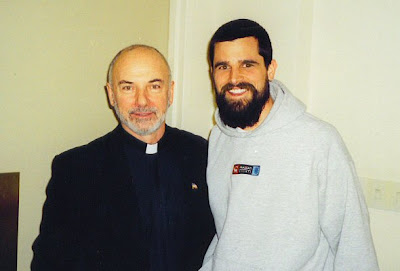
By the way, for those who don't know me personally, despite the pictures, the beard is unfortunately gone.

Abbaye Sainte-Madeleine, Benedictine Monks


Hat tip to Vocation Station

Tuesday, March 4, 2008

Time to VOTE!!!


Roman Catholic Vocations has been nominated for 5 Catholic Blog Awards:
-
Best Individual Catholic Blog
Best New Catholic Blog
Best Overall Catholic Blog
Most Informative and Insightful Catholic Blog
Most Spiritual Blog
-
Voting is open until Monday, March 17th, but why wait? Please consider heading on over there and casting your votes. Votes in any or all of the above categories would be greatly appreciated. Even if you don't vote for this blog (please do), take the time to vote for many of the great Catholic blogs out there in blogosphere.

FSSP Diaconate Ordinations


If you are interested in seeing some beautiful and extensive ordination photos, go HERE and scroll down to see a slideshow of the recent Priestly Fraternity of St. Peter Diaconate ordinations. It was great to see Fr. Ferguson, FSSP in the pictures (subdeacon). Fr. Ferguson assisted at the Cathedral in Raleigh for the Solemn High Mass this past January.


Hat tip to New Liturgical Movement

Another PCED response about seminarians and, this time, Latin requirements

A post from Fr. Zuhlsdorf's blog:


"You might recall that I posted a letter sent by the Pontifical Commission Ecclesia Dei (PCED) to a questioner asking about the rights of seminarians to be trained in the use of the 1962 Missale Romanum as well as, presumably, the Rituale Romanum.

I just received a copy of another letter from the same PCED to someone making inquiries.

The response of the PCED Secretary, Msgr. Camille Perl, repeats what we knew from the other letter, namely, that seminarians have the right to be trained to use the older form and that seminaries should provide that training.

Then there is a third response:

3. There is no plan to implement a generalized Latin test for seminarians and priests who wish to celebrate Mass according to the extraordinary form of the Roman Rite, but it is expected that those who celebrate should have a sufficient mastery of Latin to be bale to read, pronounce correctly and understand the sacred texts which they must recite or sing.

We expect that these matters will soon be treated in an instruction on the application of the Motu Proprio Summorum Pontificum.

I like the use of the word "soon" in relation to the "instruction on the application" of Summorum Pontificum.

So, here we get a little direction about the concept behind idoneus. The PCED says there will not be a test for Latin. However, that does not mean there can’t be tests. (That would, of course, open up the whole "double standard" issue again.) The PCED speaks of "sufficient mastery" of a) reading, pronouncing, and c) understanding texts. There is no indication of what "sufficient mastery" is, but it is a start. I think "to read" and "pronounce correctly" are pretty much the same thing, unless "to read" and "understand" are the same. Either way, the letter does indicate that whatever the priest reads aloud must be pronounced properly.

However, I can usually tell when the person reading Latin actually grasps what he is reading aloud… or not. For example, I know a pastor of a large parish known for its Masses in Latin who clearly can pronounce Latin words. However, he sings texts in such a way that it is clear he really doesn’t hear what the texts mean while he sings them. I grant that texts can be read in different ways, to stress now one thing, now another. But, when a guy doesn’t have a clue, you can tell. And then there are those who use speed to give the impression of expertise. But I digress…

There is always going to be a connection between the sound and the meaning.

In any event, this letter of the PCED is another indication that we will soon have more direction."

Monday, March 3, 2008

Vocation inquiries increased 30 percent in 2007, survey finds

I've been out of the loop for little while. Bishop Burbidge, Fr. Shlesinger and I were at St. Charles Borromeo Seminary last week, and I had diaconate formation this past weekend. This VISION Vocation Guide came out last week, but I didn't have time to post on it. I will try to get the Guide itself up here for resources sake.
Catholic News Agency STAFF, Feb 29, 2008 (CNA).- A new survey has revealed that Catholic religious communities in the United States have increased the number of individuals they have in initial formation by 30 percent. Furthermore, 62 percent of communities participating in the survey reported an increase in vocation inquiries last year.

The figures come from the VocationMatch.com Second Annual Survey on Trends in Religious Vocation. The survey was sponsored by VISION Vocation Guide and published by TrueQuest Communications of Chicago on behalf of the National Religious Vocation Conference.

The results come from surveys of 1096 discerners, of whom 320 responded, and 476 vocation directors, of whom 225 responded. Researchers also examined and compared, inquirer profiles, using 3,422 profiles from late 2007 to mid-2008 and 5,591 profiles from late 2006 to mid-2007.

The majority of individuals considering religious life are under thirty. One in five respondents plan to enter a religious community in the next year, while another 64 percent are “seriously considering it.”

About 73 percent of respondents considered “essential” or “very important” both praying in community and devotional prayer. Living a life of faithfulness to the Church and her teachings was ranked as “very important” or “essential” by 90 percent of those in discernment.

Vocation directors for both women and men commented on an increased interest among inquirers in wearing a habit or traditional religious garb.

Personal contact with a religious priest, sister, or brother was considered “essential” or “very important” in obtaining vocation information by 82 percent of respondents. Communities’ websites were considered “important” or “very important” sources of vocation information by 70 percent of respondents. Using prayer as a discernment tool was ranked as “essential” or “very important” by 97 percent of respondents.

Inquirers believed the “discipline of prayer” would be the most difficult part of religious life, followed by a vow of celibacy and a life of service. Discerners ranked “living with people who are not my age” their least important concern.

Respondents noted that they were most surprised by the “diversity of communities and spiritualities,” and also found “great joy” among religious men and women. Some were most surprised that they were considering religious life at all. “A year ago I would have laughed if someone had suggested that I enter into religious life," one young man said.

Patrice Tuohy, executive editor of VISION Vocation Guide and VocationMatch.com, commented on the survey results, saying, "Religious vocation as a life choice has been off the radar screen for too long. What this crop of discerners is finding is that the option of life as a brother, sister, or priest may be the one that satisfies their heart's desire above all else."

Vocations and Catholic Schools

From Fr. Kyle Schnipple, Director of Vocations for the Archdiocese of Cincinnati:

During Catholic Schools Week, I was looking over our files on how many of our seminarians are graduates of Catholic high schools in the Archdiocese. The number surprised me, as I found only nine of 28 of our currents seminarians had done so. I expected a higher number, especially considering we have one of the largest Catholic school systems in the country. Plus, I remember stories of huge numbers of grads from the schools entering the seminary each year, between ten and fifteen every year from Elder High School, alone. Yet now, we have one Elder alumnus in formation. (For the sake of completeness, there is one graduate from each of the following in formation: Alter, Badin, Carroll, Elder, Fenwick, Moeller, LaSalle, Springfield Central Catholic and Summit Country Day.)

To an extent, I can understand the drop off, for I taught in the system the first two years after I was ordained, and I know the pressures first hand that are put on the administrators and teachers by not only the state regulations, but also by the alumni, parents, and even the students. But I still wonder if we might be missing some aspect of education.

I fully admit that when I was teaching, my primary goal was to instruct my students in the ways of the New Testament and the person of Jesus Christ. Yet, there is a further dimension to the process that I missed then, and am only now coming to realize: education, especially in the Catholic sense, is not just about teaching the faith; it is about helping the parents to form their children as disciples of Christ. This is the key, in my understanding, to not only an increase in the number of seminarians, but also the revitalization of the Catholic Schools. It is not enough to teach each student, because the public schools can do that. Rather, each student needs to come to the realization that there is some special path that God is leading him or her down, a path that leads to a unique spot in this world, in the Church, which only this one particular student can do: the mission, (the vocation, in a broader sense) that this student has been given by God to enrich the world. Not a small task, by any means!

Accomplishing this new movement, though, can be done through some easy steps, I believe, and it begins with parental involvement, as they are the ‘first teachers of their children in the way of faith.’ Their witness of discipleship helps to shape their children as disciples. The witness of those who have chosen radical discipleship as a way of life also gives a favorable impression to the next generation. The current class of seminarians are excellent speakers and witnesses of how following Christ as a disciple can lead to a tremendous and wonderful thing. In addition to bringing seminarians to the schools, bring the schools to the seminary or visit convents that in your area. The witness of the aged members of the communities who have served as a religious for 70 years inspires me to want to give even more in my own journey as a disciple.

But even with the witness of those who have given all to following Christ, the next generation will not be able to follow Him if they first do not know Him. Both the Catechism of the Catholic Church and the newer US Catholic Adult Catechism give the basis of the faith, and lead the reader into a deeper relationship with Christ. Both of these wonderful resources are dripping with Scripture citations, highlighting the need to know and read Scripture, for ‘ignorance of Scripture is ignorance of Christ,’ as St. Jerome so wonderfully said.

Finally, a perpetual challenge is to make the connections for the students through the curriculum, especially highlighting how the Church led so many innovations and discoveries throughout history. John Henry Newman stated, in his Apologia Pro Vita Sua, that to be a student of history was to cease being Protestant. His study of history led him from atheism through Anglicanism to the fullness of the Church in Catholicism.

Does the faith highlight and inform everything that happens in our schools? If so, we will be turning out disciples ready to serve Christ in radical ways.